

THE COCOANUT GROVE
3400 Wilshire Boulevard, Los Angeles, California
“Night-Life Center of Smart Los Angeles and Hollywood”
Hard to imagine at the time but a rural dairy farm situated on 160 acres of wilderness would be transformed into the fast-growing city of Los Angeles,’ most influential resort hotel and nightclub. Once considered too remote from downtown to have any real value, this land would evolve into some of the most desirable property west of the downtown commercial core. With the development of the Ambassador Hotel and Resort (originally to be named The California); Wilshire Boulevard would become a magnet for residential and commercial real estate investment and, consequently, help fuel the movement west.
Location always matters in real estate, and many of Los Angeles’ old money crowd had made their stately homes in the nearby enclaves of Hancock Park, Larchmont and Windsor Square. All that wealth and influence needed a place to mingle, to play and to outright showoff. The Ambassador Hotel and Resort would be the perfect venue for it all, and then some.
This grand complex was designed by the renowned architect Myron Hunt. Hunt had built an impressive résumé with numerous residential projects in Evanston, Illinois. He came West to design the Potter Hotel (1902) in Santa Barbara, and later The Hotel Maryland (1903–1904) in Pasadena. His success with the Pasadena’s large scale Huntington Hotel (1907) which he designed with Charles F. Whittlesey, proved he was more than up to the challenge for this proposed new resort hotel.
Hunt’s design for the Ambassador Hotel and Resort was on a scale and scope the growing city of Los Angeles had never seen before, or since. He incorporated the advantages of the sunny weather and the multiple vistas available from the massive track of land in his design. The resort hotel would soon boast of its now prime location in promotional advertising, “eight minutes from the financial center and fourteen miles from the Pacific Ocean.”
In the early 1900’s the mild winter temperatures offered by Los Angeles, Hollywood and Pasadena had become a Mecca for the wealthy to “winter” and the Ambassador Hotel and Resort would capitalize on this yearly migration from the mid-west and eastern states.
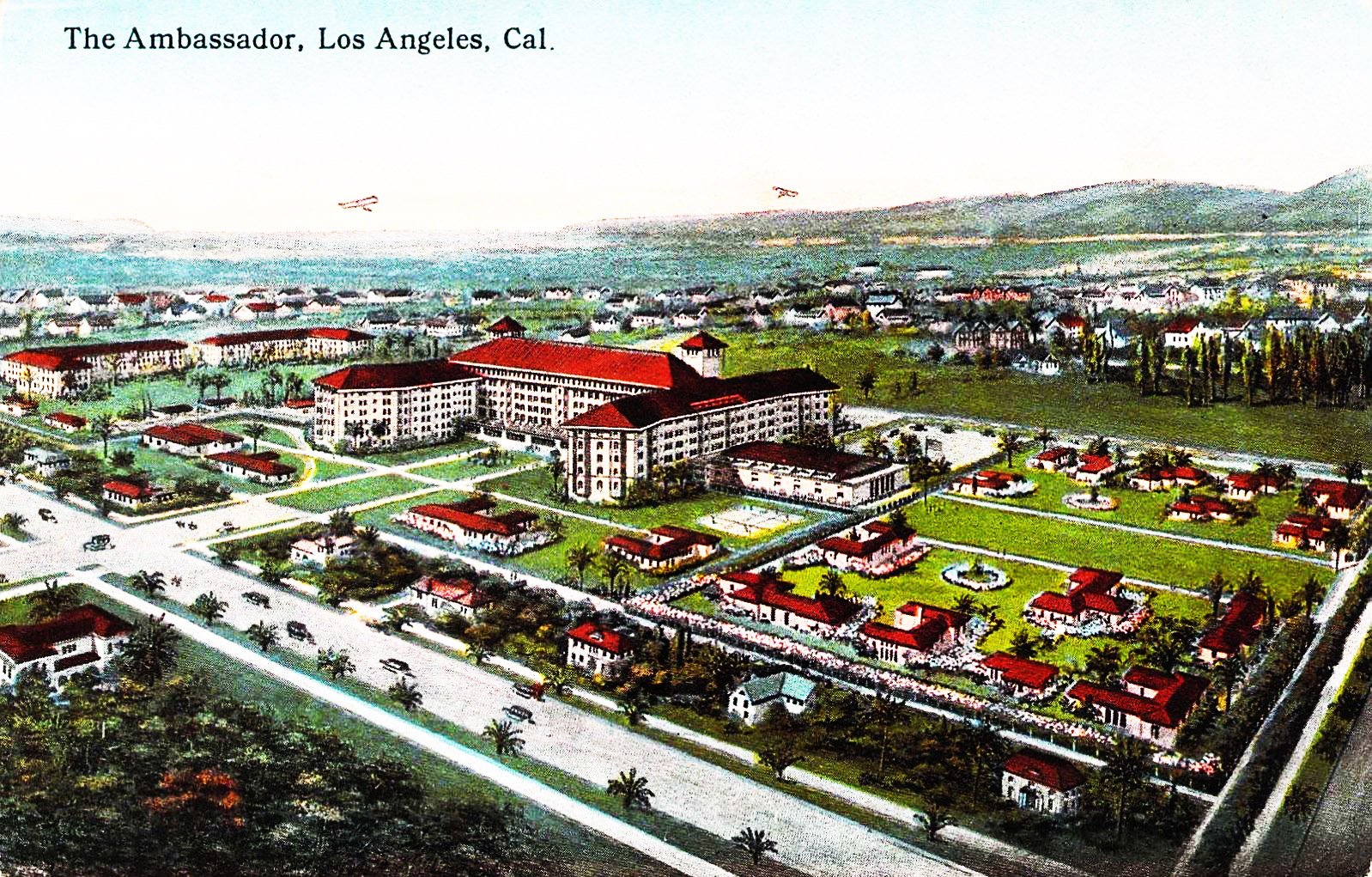
The Ambassador Hotel Resort with adjacent bungalows and villas circa 1920s
When it opened on New Year’s Day 1921, the main building consisted of 444 rooms for guests, all designed to be bathed in California sunlight. An additional 60 rooms were available to house the servants and staff of the more affluent guests. And the private Villas/bungalows would accommodate an additional 76 long-term residential guests. Construction of the project was managed by renowned architect McNeal Swasey.
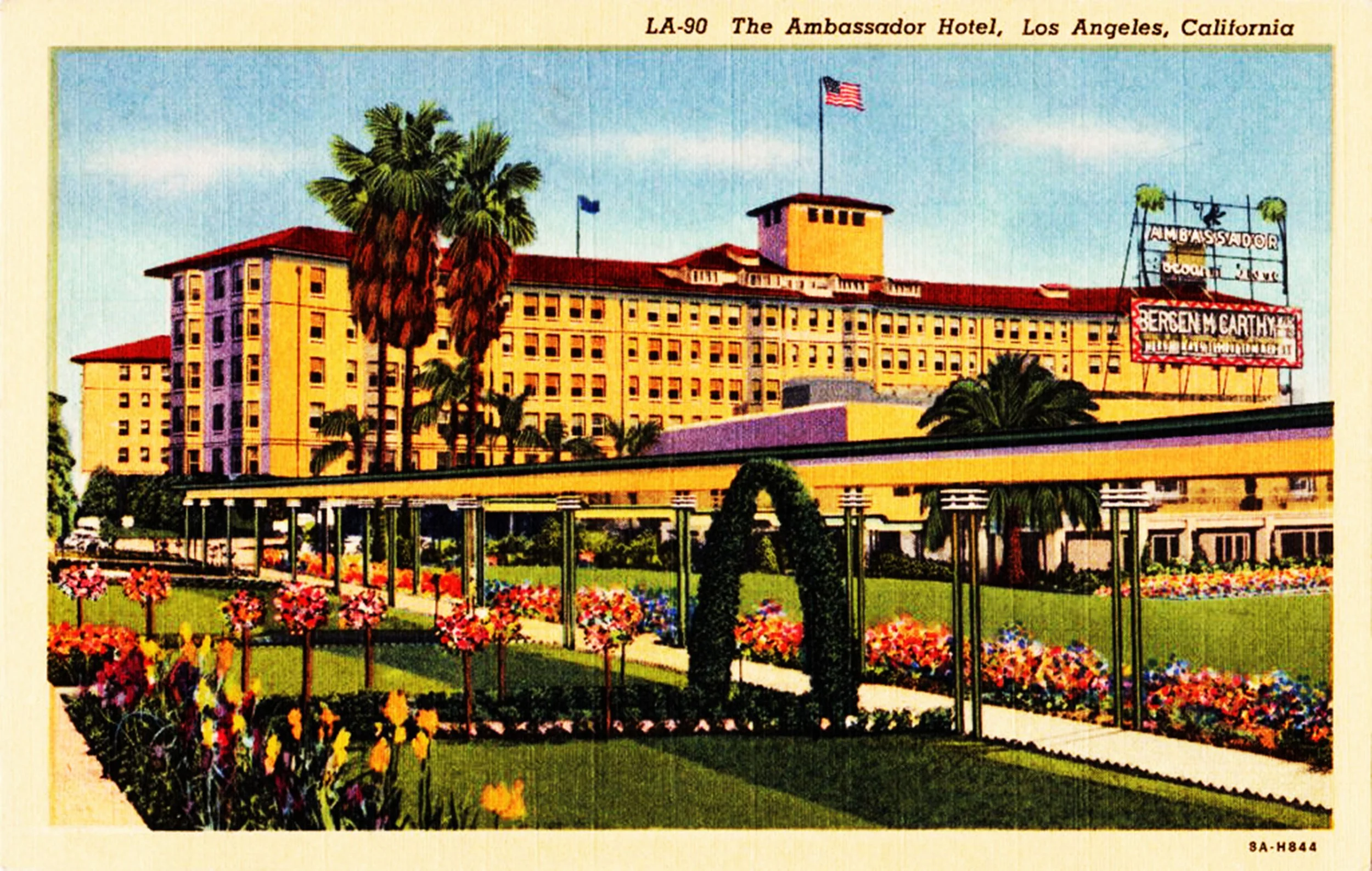
The Ambassador Hotel’s sprawling landscaping included pergolas and gardens
The landscaping was of a grand scale as well, featuring 8 acres of lawns, mature trees, cactus gardens, flowered pergolas providing shady walk-ways that would lead to quiet, private nooks. The hotel had its own nursery to supply the resort hotel’s landscaping needs, utilizing 3 acres for on-site propagating of shrubs, plants and flowers with a crew of 25 gardeners tending to 60,000 different varieties. This abundance of flora helped to supply the fresh flowers found in every room which would become one of the hotel’s trademark amenities. Banana, orange and lemon trees supplied a bounty of available fresh fruit for those guests willing to pick their own.
Perhaps the intended mission of this new establishment was summed up best by Ambassador vice president and general manager Vernon Goodwin who boasted at the opening, “This hotel stands for the ultimate in hotel service and accommodation, and will be the center of the social life and color in Southern California. As many resorts in Europe are made famous by their hotels, so shall Los Angeles with its unsurpassable climate and great charm. The opening of the Ambassador will be a powerful magnet to attract the pleasure seeker, the investor, the house builder and the film maker. Its opening is an important milestone in ultimate development of this favored community.” By all accounts, the luxurious compound would live up to Goodwin’s optimistic boast for over four decades.
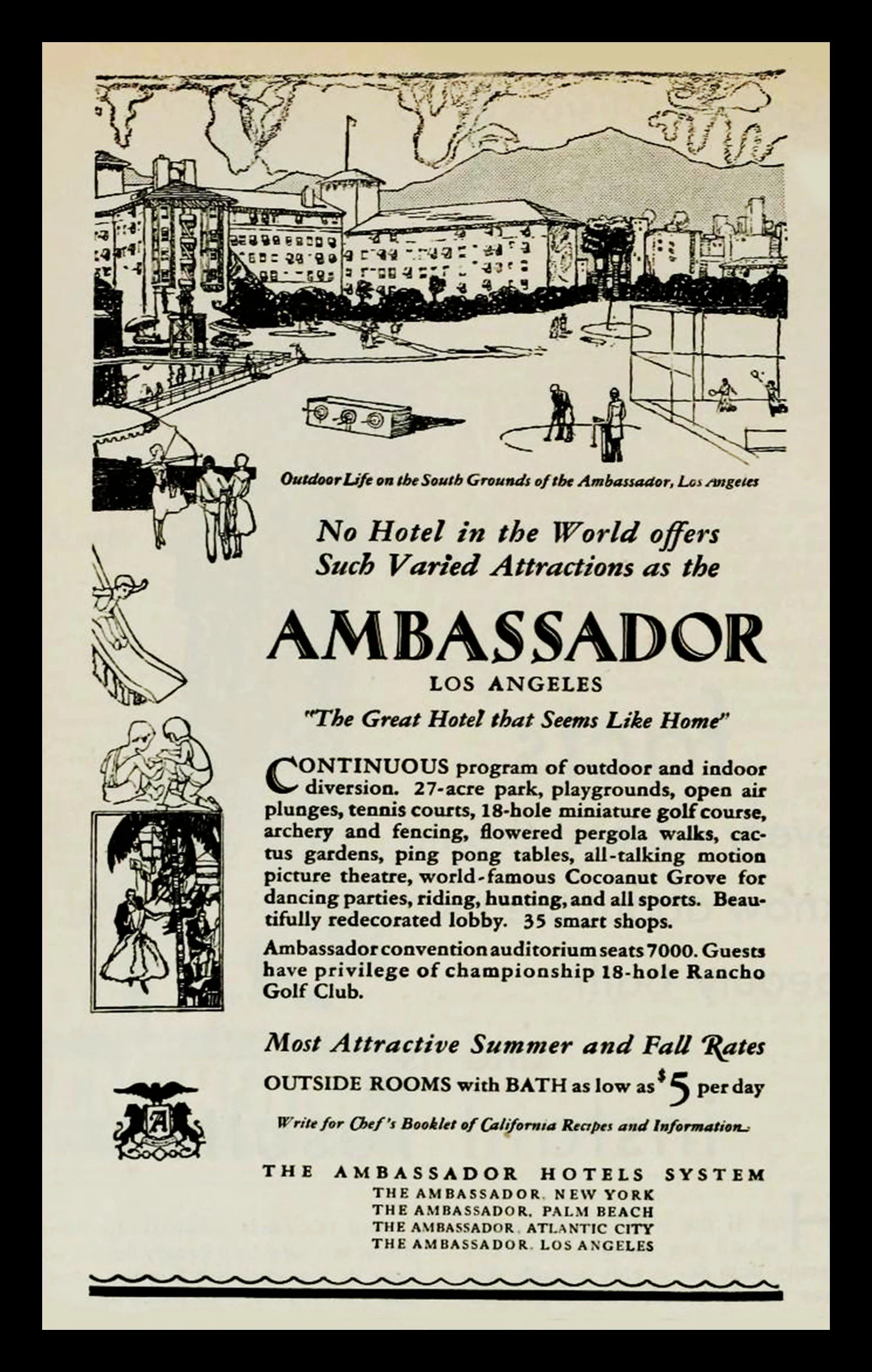
An Ambassador Hotel ad featured in a 1930 Photoplay Magazine
This sprawling new resort was truly a self-contained small city, requiring a staff of up to 1000 to keep things running smoothly. In addition to Room Service, food and drink were available in a number of locations, including the French Room, the Embassy Room, the Fountain Room, Palm Room, and Casino. The hotel featured its own post office, movie theater, Doctor and Dentist offices, lounge, gallery of trendy shops and boutiques including an I. Magnin & Co., travel agency, smoke shop, barber shop and hair salon. With all these amenities on site you could literally live here year-round, and many moneyed guests did just that.
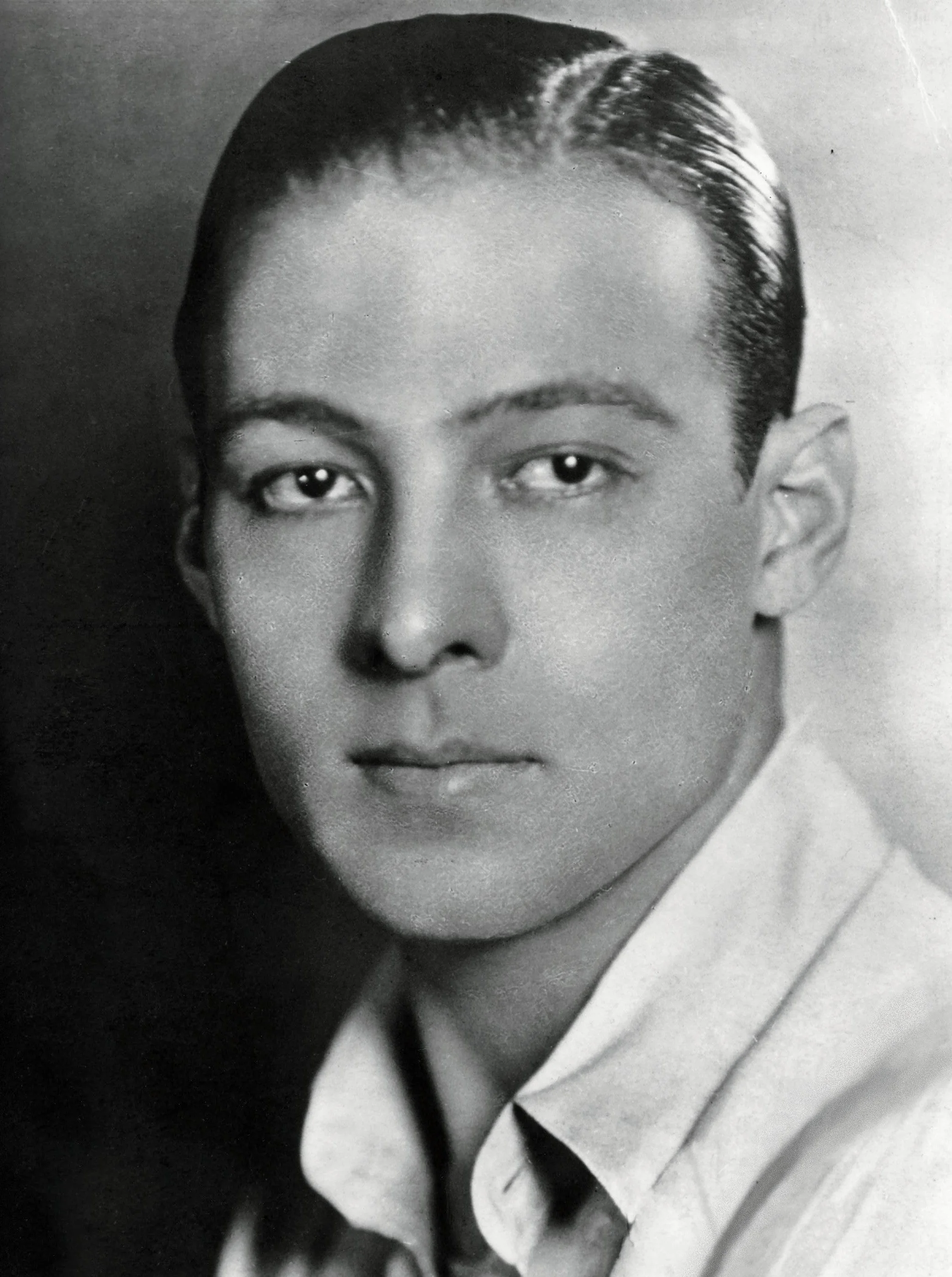
Rudolph Valentino
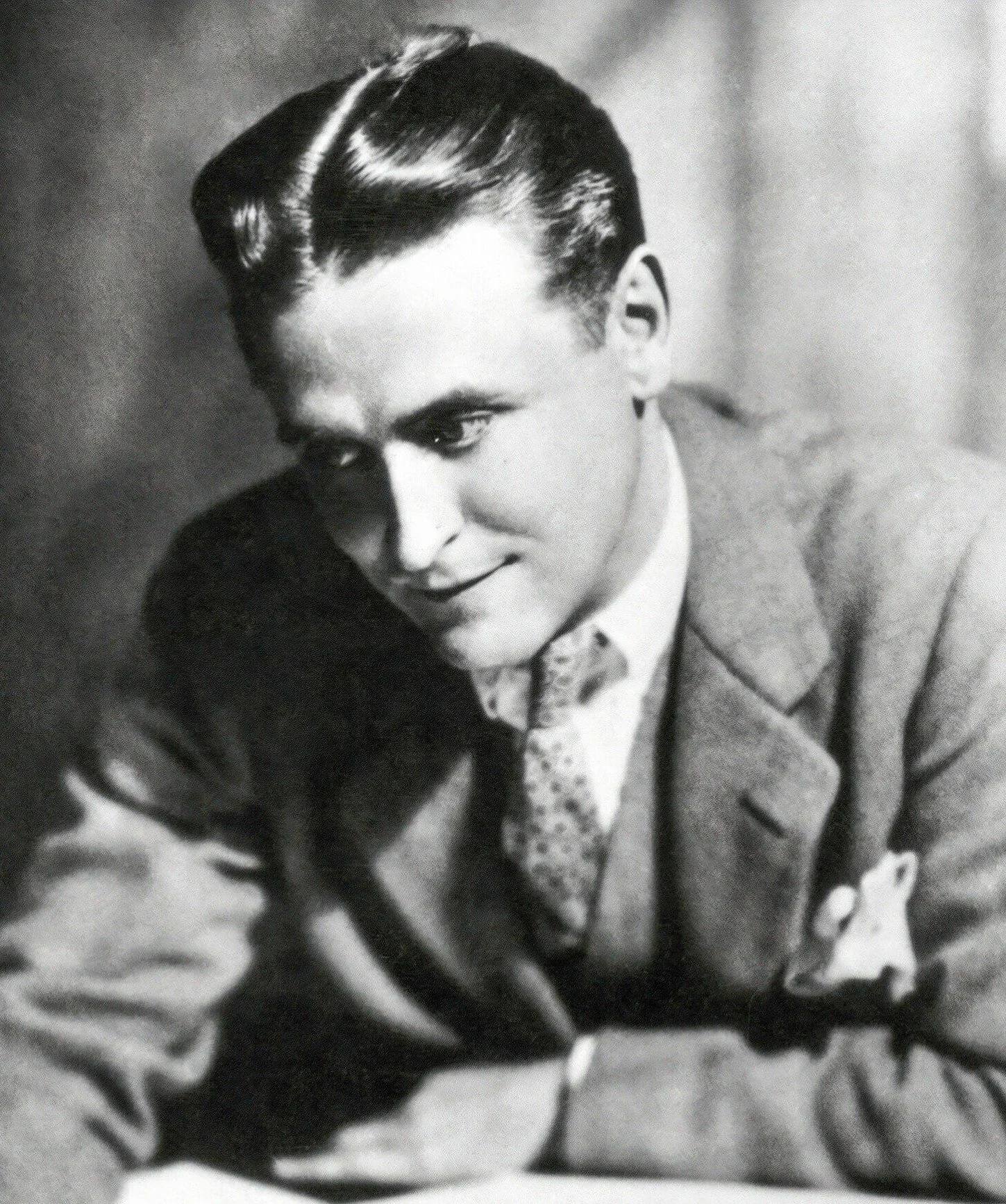
F. Scott Fitzgerald
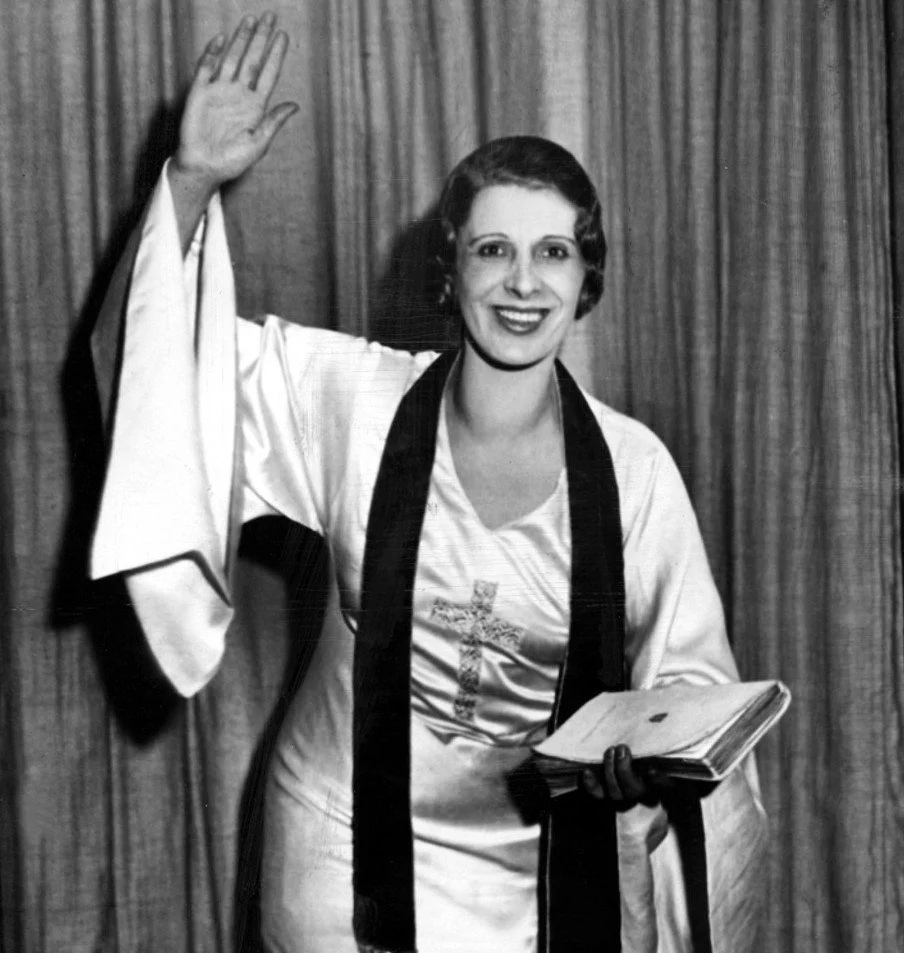
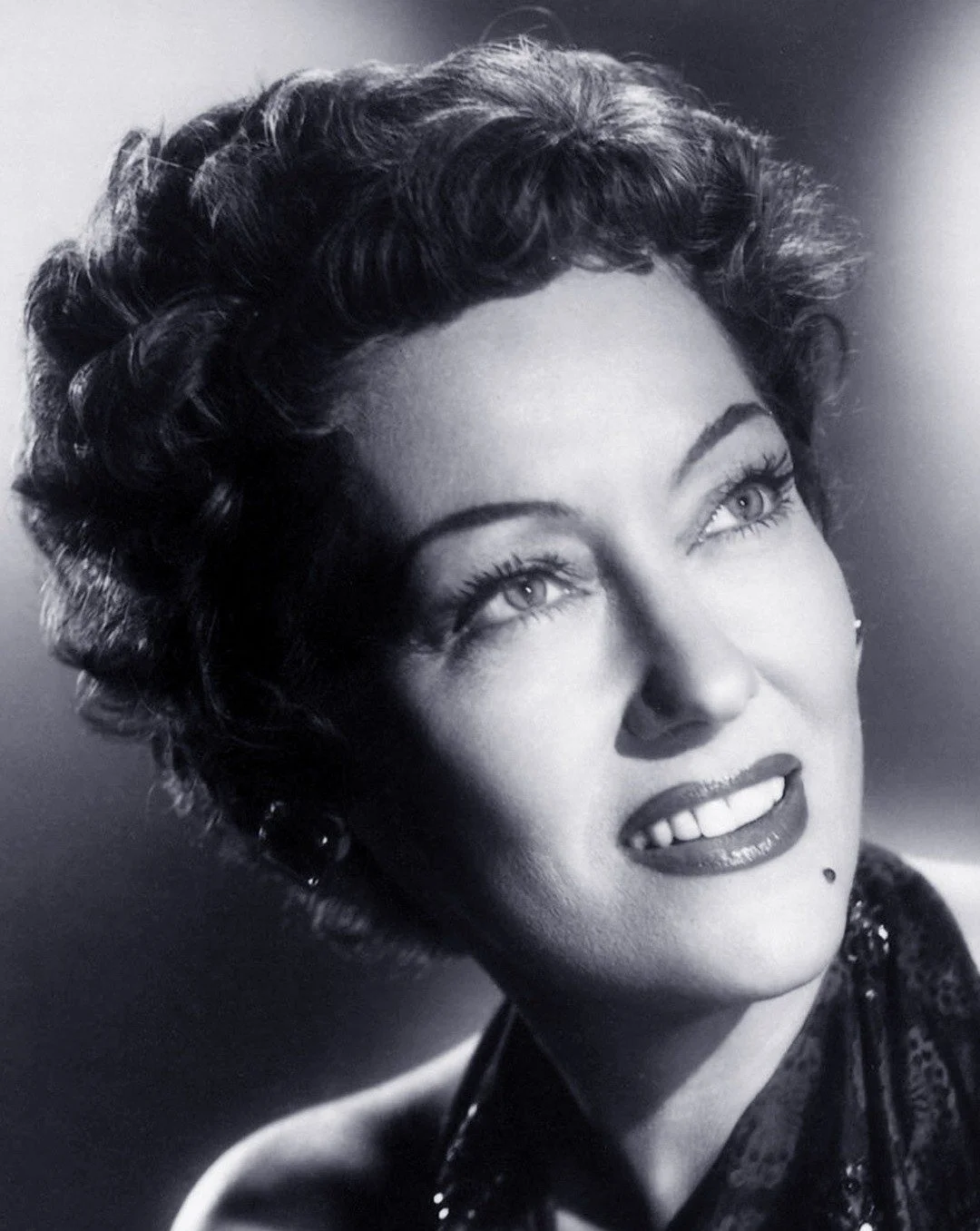
Aimee Semple McPherson and Gloria Swanson
Residents of the on-site Spanish Villas bungalows and the suites within the hotel included Gloria Swanson, Pola Negri and Rudolph Valentino, Jetta Goudal, Clara Bow, F. Scott Fitzgerald, radio evangelist Aimee Semple McPherson, theatre impresario Sid Grauman, gossip columnist Walter Winchell, Brown Derby restaurant co-owner Wilson Mizer, actress Marion Davies and media mogul William Randolph Hearst. John Barrymore and his beloved female pet monkey Clementine lived in a bungalow suite that was furnished with borrowed items from the Warner Bros. prop department, which Barrymore eventually bought. Even the unpredictable Howard Hughes lived at the hotel with his first wife, Ella Botts Rice when arriving in Los Angeles.
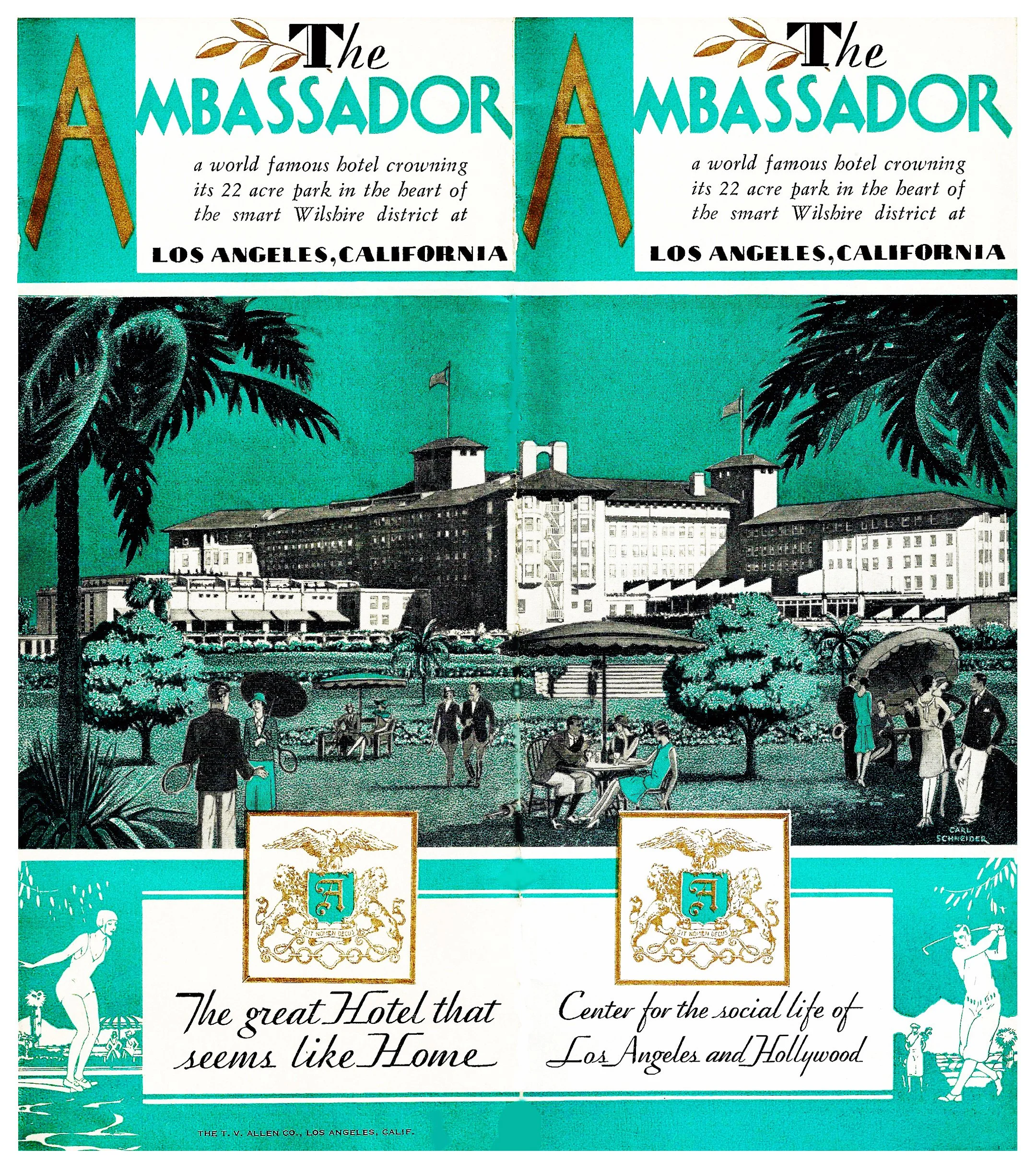
A brochure for the world-famous Ambassador Hotel and Resort
The 23-acre development offered something for everyone with an emphasis on outdoor recreation. For the equestrian, the hotel offered bridle paths, riding rinks and horse stables and the hotel’s massive front lawn hosted horse jumping competitions.
For your strolling pleasure, the hotel offered garden paths and 1300 feet of vine covered pergolas leading to the private Villas that surrounded the eastern boundary of the property.
An Olympic- sized outdoor swimming pool, was a popular attraction, often used by swimming professionals Olive Hatch, Duke Kahanamoku, Johnny Weismuller and Buster Crabbe.
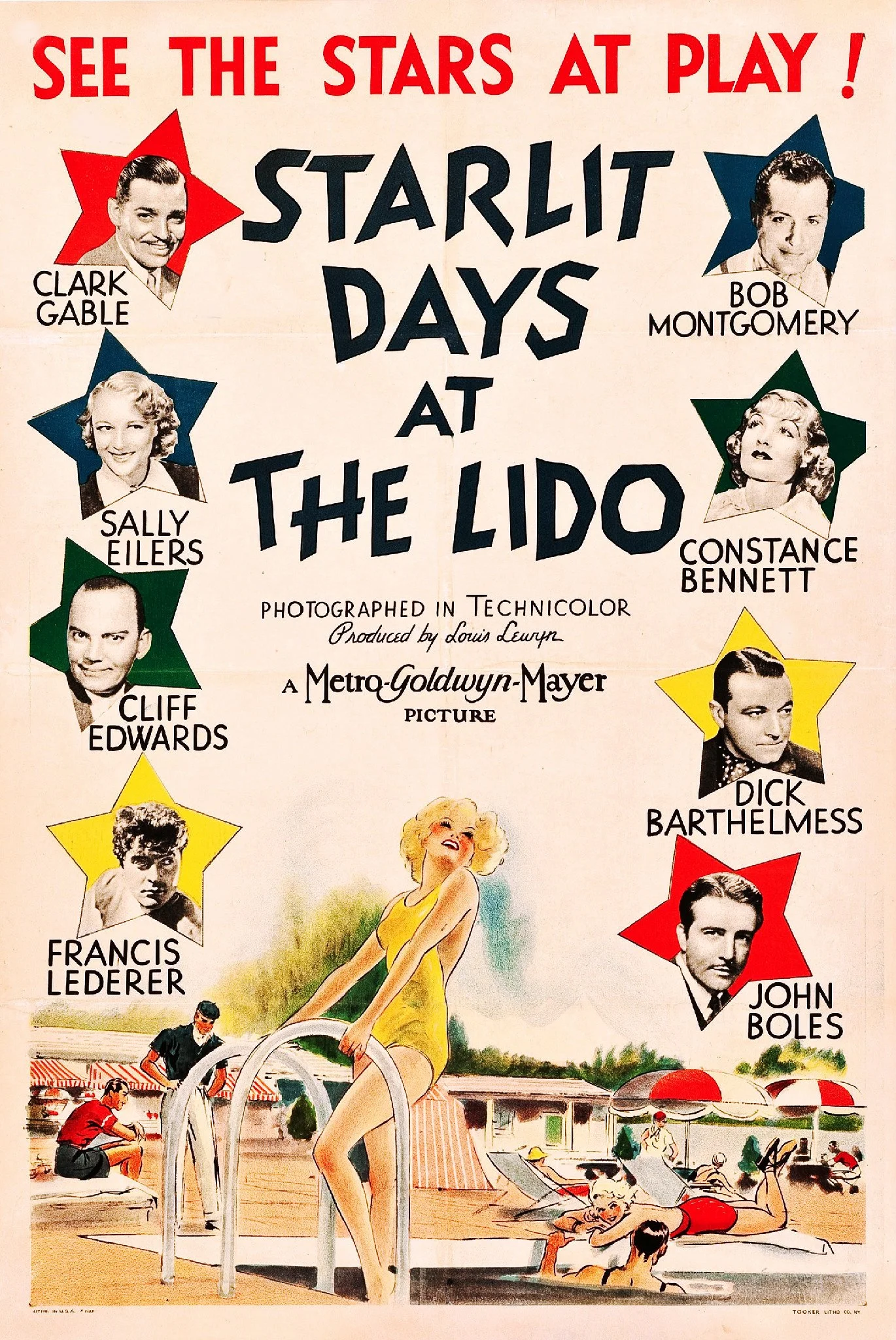
Starlit Days at the Lido was filmed at the hotel in 1935
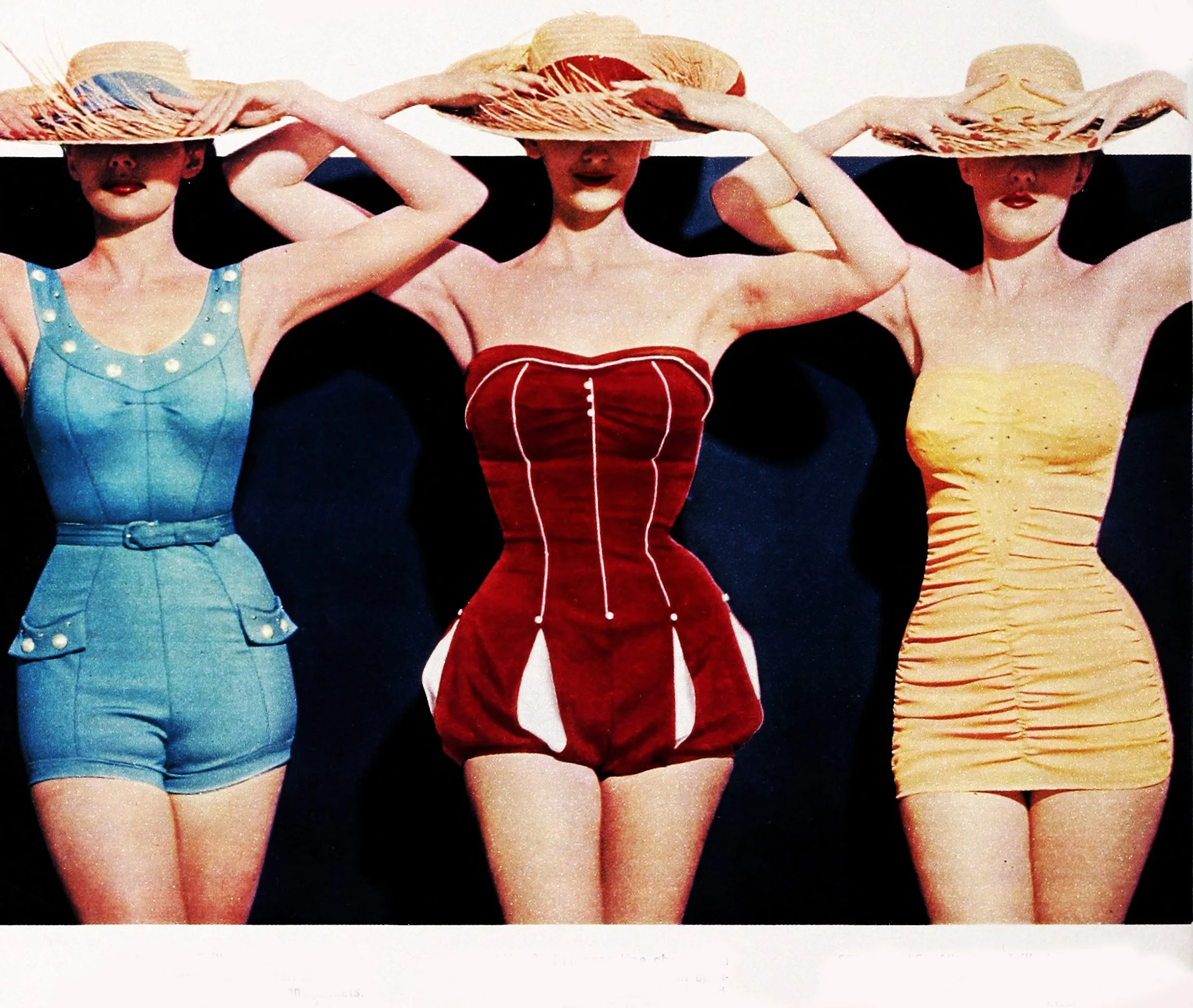
Swimsuit fashions for the Ambassador Hotel and Resort
Poolside was where you would find the famous Lido featuring its Sun-Tan sand beach, private cabanas, conditioning salon and, after the repeal of Prohibition, the unique Sheltering Palm bar; built around a mature, shade providing Canary Island date palm.
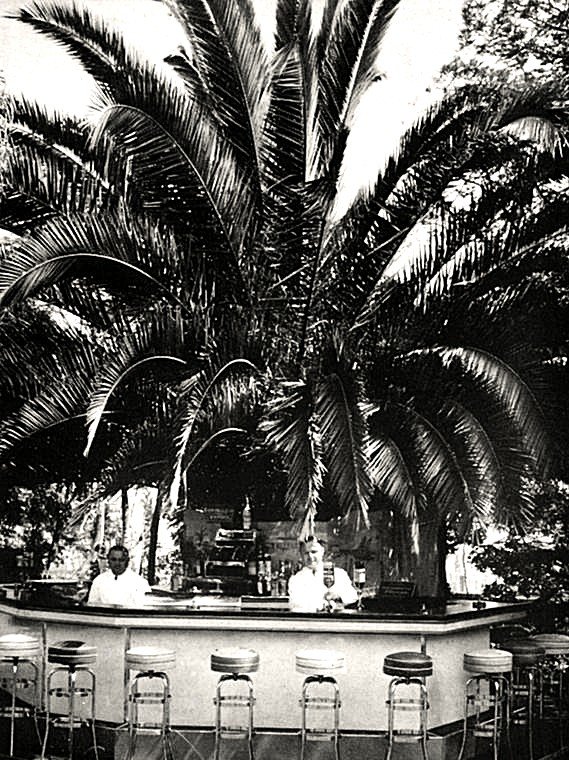
The poolside Sheltering Palm Bar
A miniature golf course was a favorite of Howard Hughes, Katherine Hepburn and Marion Davies. The Ambassador’s tennis courts hosted many a tournament featuring Champions “Big Bill” Tilden, Gene Mako, Jack Tidall, and Don Budge. Cheering them on were regular attendees Clark Gable and Carol Lombard, Charlie Chaplin, Boris Karloff, and movie mogul Samuel Goldwyn. Also available to guests were everything from archery and fencing to ping-pong and tossing horseshoes. All these sports options attracted the interest of great athletes from around the world including baseball’s great Bambino, Babe Ruth.
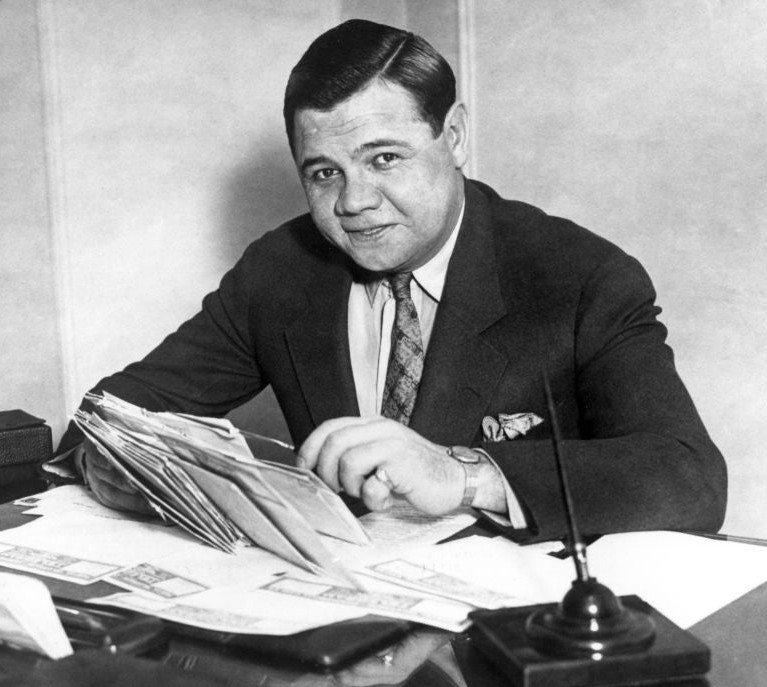
Babe Ruth was one of many sports celebrities to favor the Ambassador Hotel and Resort
After participating in all those strenuous day time outdoor activities, those hotel guests and year-round residents needed a place to go at night, to eat, drink and be merry. Catering to that need was the Cocoanut Grove, which opened less than four months after the hotel, on April 21st.

The Moorish-Moroccan themed Cocoanut Grove interior
Architect J.R. Davidson designed the interior of the Cocoanut Grove with a Hollywood influenced exotic Moorish- Moroccan theme, including fake palm trees left over from the Famous Players-Lasky set of Rudolph Valentino’s The Sheik (1921), with stuffed fake fur covered monkeys (with electrified amber eyes) and coconuts hanging from the imitation palm fronds. Patrons swore that at least one of these monkeys was real, only to find out that Ambassador Hotel resident John Barrymore’s beloved pet monkey Clementine had the run of the place whenever The Profile was in attendance.
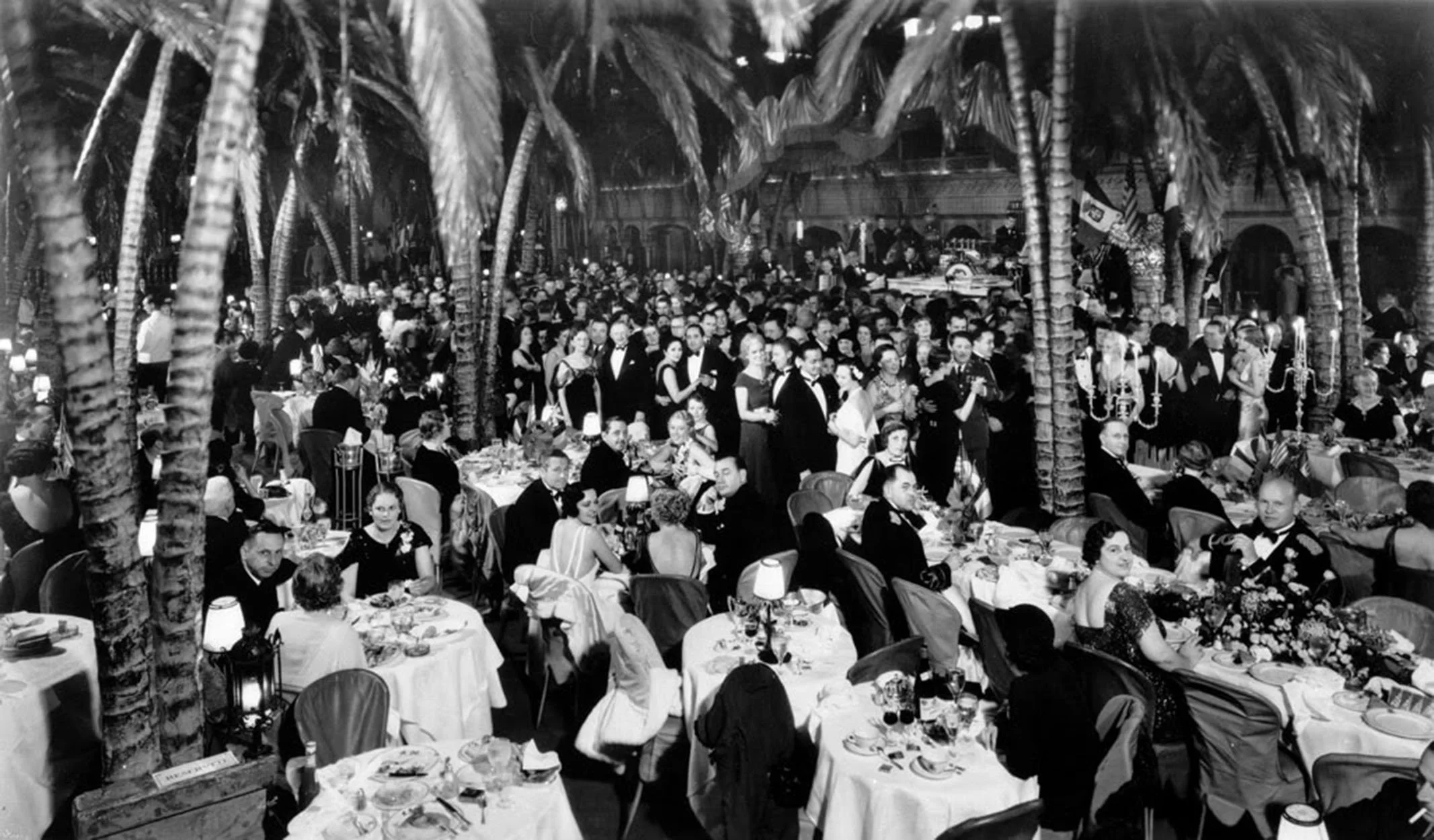
The Cocoanut Grove hosted countless formal dinners and banquets
In this 1,000-seat grand ballroom, the old money of Los Angeles represented by the Dohenys, the Chandlers and the Huntingtons would intersect with the new money of Hollywood, represented by the DeMilles, the Fairbanks and the Hughes.
The Cocoanut Grove would become a popular gathering spot for both factions. This was somewhat remarkable, given the fact that less than a decade earlier, the members of the motion picture community had been shunned by the established community as vulgar, uneducated and uncouth. Never underestimate how money, and lots of it, can change people’s perspectives.
Since the hotel and the Cocoanut Grove opened during Prohibition (1920-1933) the management felt compelled to print this at the bottom of their menus:
We respectfully request our patrons to obey the law and refrain from indulging in the use of intoxicants or bringing same upon our premises. By conforming to the above you will save yourself embarrassment and humiliation and you will also be protecting our interests. The Volstead and Wright acts make you liable for imprisonment for violation of same, and we ask your earnest co-operation in complying therewith.
Obviously, this was meant to discourage any BYO hooch from being brought on site, but given the proliferation of bootleggers in town, the odds are that the plea fell on mostly deaf ears.
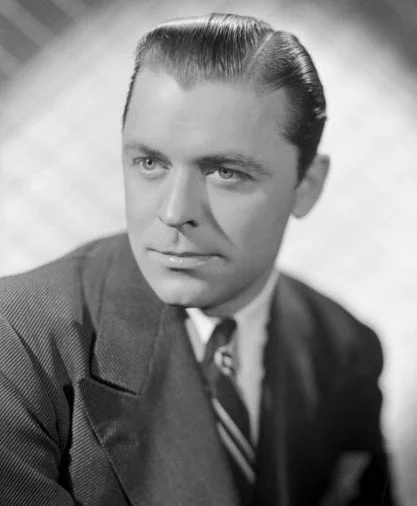
Lyle Talbot
This was the era when most people, no matter their means, always dressed to impress and one of the best places to impress was there. “The Cocoanut Grove was just the place to go. You saw everyone you knew there, especially on Tuesday nights. It had all the name bands with all the name singers. And that was a whole evening. You really dressed up in Hollywood then. You almost put on a tuxedo automatically,” recalled dapper actor and frequent patron Lyle Talbot.
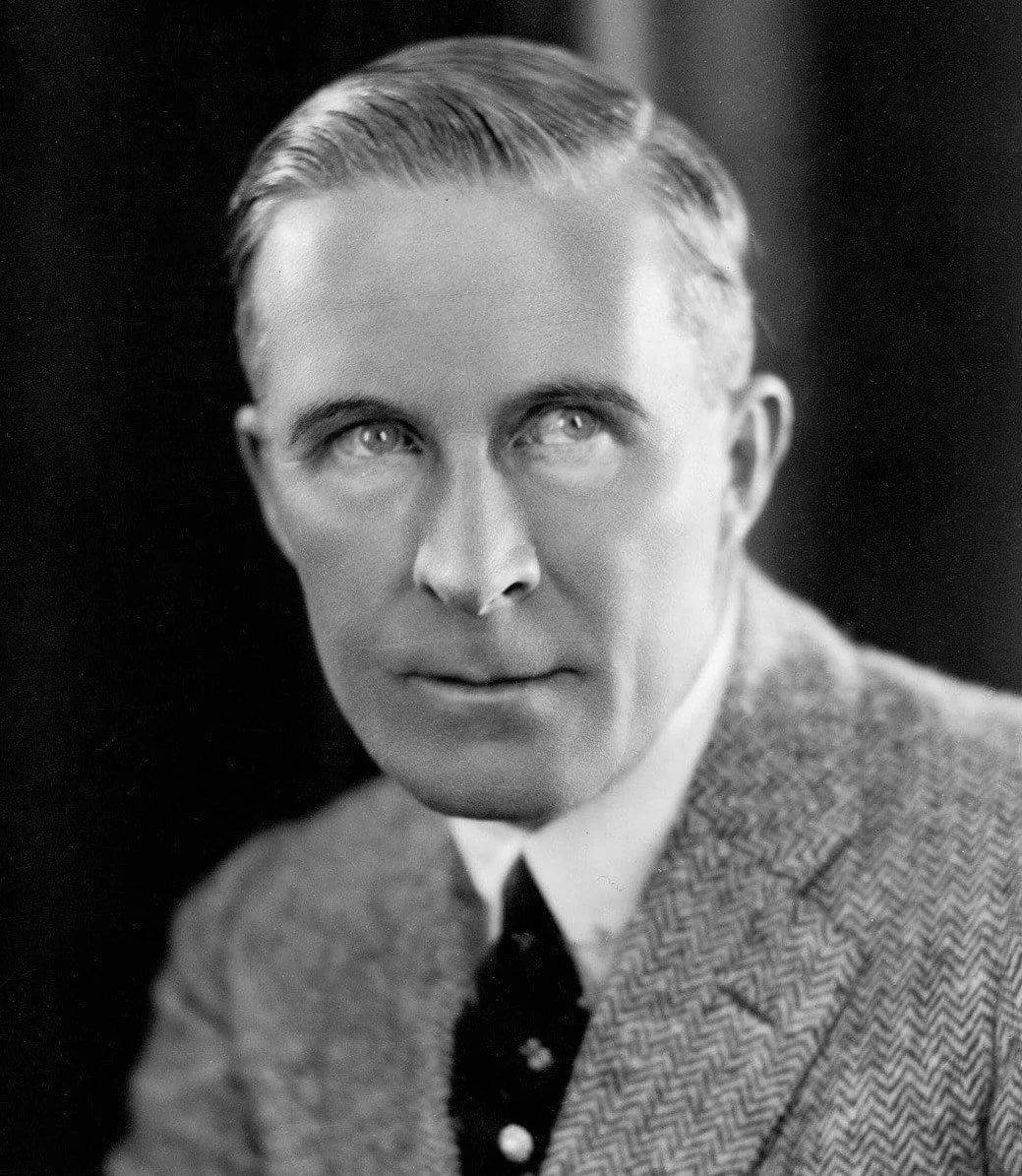
William Desmond Taylor
With great music and an expansive dance floor, the Cocoanut Grove quickly became the place to swing your partner. Early regulars, Director William Desmond Taylor and Mabel Normand, could be found having a ball on the dance floor. This was their escape after a hard day’s work. Their fun was cut short however, by Taylor’s untimely death. The mystery surrounding his murder on February 1, 1922 has remained unsolved and was one of Hollywood’s early scandals.
There were a handful of suspects, his valet Henry Peavey, his girlfriend at the time, actress Mabel Norman, actress Mary Miles Minter, and Minter’s mother Charlotte Shelby, to name a few. The murder followed two other major Hollywood scandals: the Fatty Arbuckle rape trial and the drug addiction and subsequent death of popular actor Wallace Reid. Hollywood was getting a black eye. To keep the audience from fleeing and public condemnation, the Motion Picture Producers and Distributors of America, headed by Will Hays, was formed to keep Hollywood on its toes, morally.
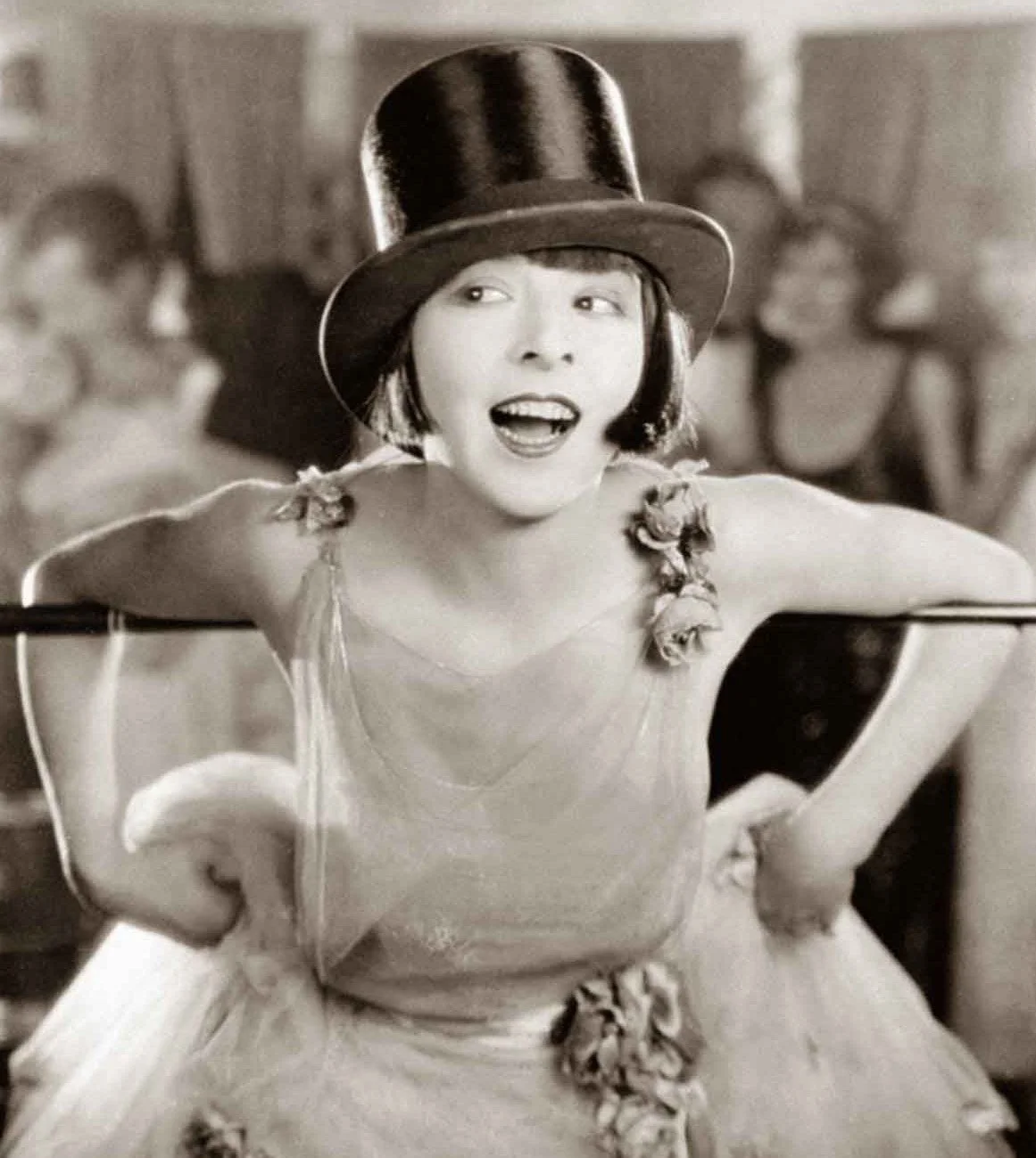
Colleen Moore
In 1923, Colleen Moore was invited to a big Hollywood bash there hosted by writer Rupert Hughes, Howard’s uncle. Her boss, Samuel Goldwyn, had been invited and she wanted to make a grand impression. She asked the head of the studio wardrobe department, Sophie Wachner, if she could borrow the gown Moore had worn in a scene of a movie currently in production.
“I went to Miss Wachner now and begged to be allowed to wear the beautiful dress to the party that I was wearing in Look Your Best. She said, ‘Yes, if you watch out for the catsup and don’t wiggle around in your chair. The beads can’t be duplicated.’ During the party Mr. Goldwyn asked me to dance. He said, ‘That’s a beautiful gown you’re wearing. And expensive looking.’ I thanked him and thought, ‘It is expensive. It cost you five hundred dollars. And if you knew I was wearing a gown being photographed in the middle of a picture, you’d flip.”
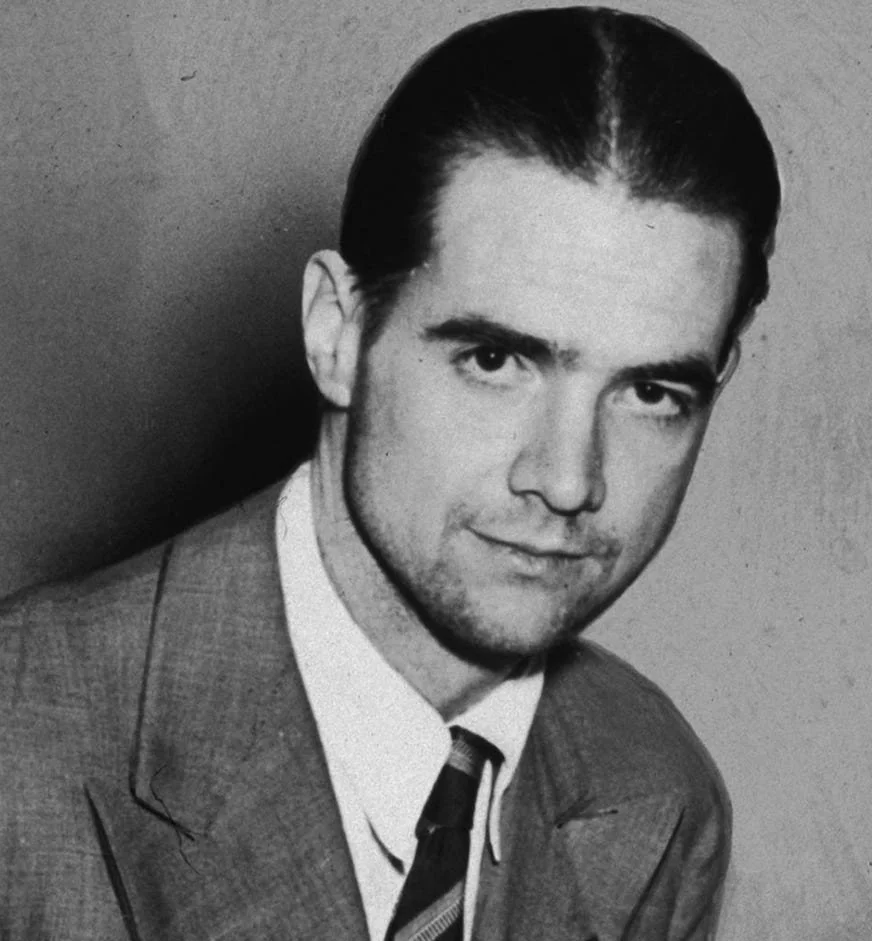
Howard Hughes
When his wife was out of town, it was there that a young Howard Hughes would establish his budding reputation as a Hollywood playboy. Of course, the big bank account and the flashy 1925 Rolls- Royce Silver Ghost Piccadilly Roadster didn’t exactly hinder his efforts.
In no time at all, Hughes’ roving eyes spotted a young blonde starlet who was dating the director, Mervyn LeRoy. Her name was Ginger Rogers and she couldn’t help notice she was being watched.
“One evening we went to a party at the Cocoanut Grove. The club had one of the best orchestras in town and it was a wonderful place for dancing. I was having a great time dancing with Merv and the other men at our table when I noticed a very tall gentleman on the dance floor, looking at me. His face seemed stern, mask-like, almost as though he was trying to keep his feelings hidden. The severity of his expression was alleviated by a half-smile that played around his lips every time his glance caught mine. I wondered at the time if this man was used to smiling or if it was hard for him. Mervyn and I were swinging around the floor as the band came to the end of a set. We stood on the floor with the other couples, applauding the orchestra, when the tall man came up to us, pulling a lady behind him. “Hello Merv,’ he said, I’m coming over to your table in a few minutes,’ and walked on. ‘Fine, Howard,” Merv answered. ‘Now that’s an odd fellow,’ he said to me as we were moving back to your table. ‘Who do you mean?’ I said. ‘Howard. The man who just spoke to me. You don’t know him?’ ‘No,’ I said. ‘That’s Howard Hughes,’ he said. ‘The Texas oilman who wants to be a movie producer. If he can produce movies as well as he can fly planes, he’s got it made.’
LeRoy’s assessment was on the mark; in a few years Hughes would achieve Hollywood fame with Hell’s Angels (1930) and Scarface (1932).

Cole Porter shares a table with Marilyn Monroe and Donald O’Conner at the Cocoanut Grove
When Prohibition ended in 1933, cocktail service in the Cocoanut Grove was offered at your table with a very impressive list of available cocktails. You could also legally wet your whistle at the popular Field &Turf Club, an adjacent full-service bar with walls decorated by large celebrity caricatures, a popular local tradition seen at the Hollywood Brown Derby and other spots.

Adjacent to the Cocoanut Grove was the well-stocked bar at The Field & Turf Club
In 1935, Stan Laurel and Oliver Hardy made a grand entrance, arm in arm, into the Cocoanut Grove, a signal to Hollywood that the media rumors the comedy team was splitting up were pure bunk. Their gesture was a declaration of solidarity, a solidarity that would last until Hardy’s death in 1957.
Soon after arriving in Hollywood, Ray Milland came there for a very memorable evening. The acts on stage that night were hit and miss, but one struck a chord, the talents of a beloved comedian.
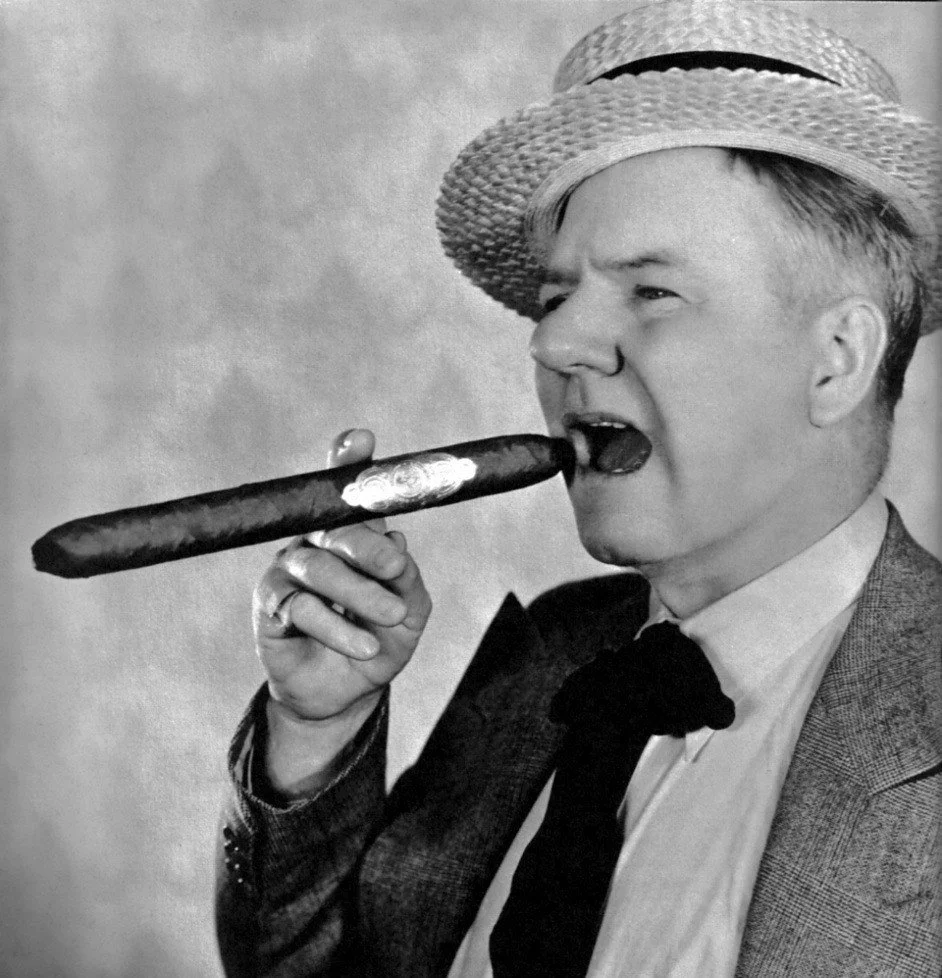
W.C. Fields
“W.C. Fields was tenderly escorted up onto the stage and demanded three cigar boxes, which he proceeded to juggle brilliantly, except that the middle one would occasionally drop to the floor. He would pick it up with the other two and go on with increasing rage, until he reduced them all to matchwood. Then he threw the debris into the piano and stalked off, demanding to see the Madame of this house of joy. Quite hilarious.”
For decades, the Cocoanut Grove would become the location of a constant series of special events including All-Star Nights, College Nights, Tea Dances, Charity Fundraisers, Formal Balls, New Year’s Eve celebrations, Women’s fashion shows, Anniversaries, and award shows, including the Academy Awards and the Golden Globes, and grand birthday celebrations.
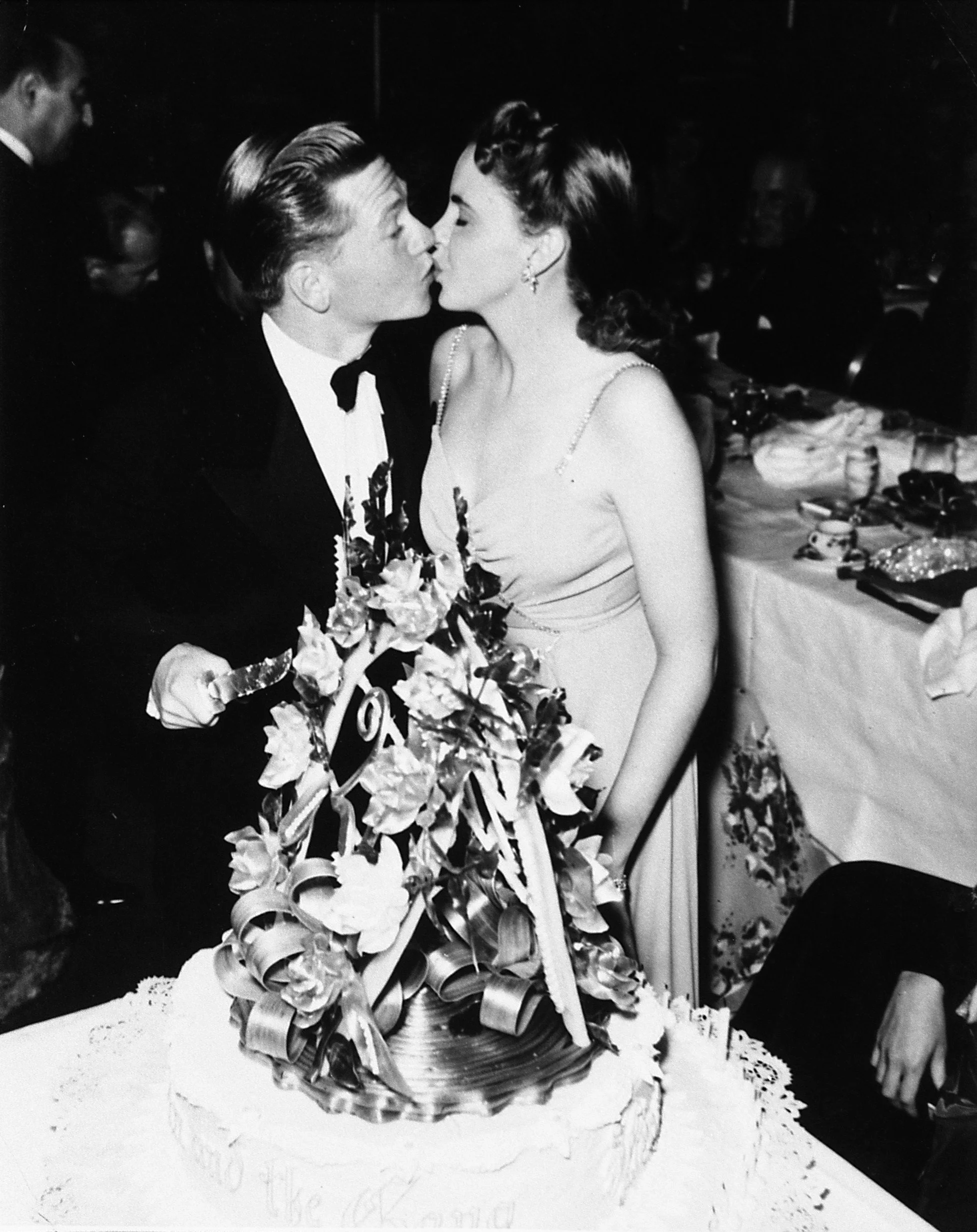
Mickey Rooney kisses close friend Judy Garland celebrating his 21st birthday party
Walt Disney had a party to celebrate the birthday of his greatest creation, Mickey Mouse. 20th Century-Fox skating star Sonya Henie celebrated her 26th birthday here. And Mickey Rooney celebrated his 21th birthday with guests that included his parents and close friend and associate, Judy Garland.
Writer and ordained “Mother Confessor of Hollywood” Adela Rogers St. Johns was a guest at an extravagant soiree given by William Randolph Hearst’s close lady friend, Marion Davies.
“It was a masquerade, then the favorite social festivity, as though spending most of their lives dressing up for the camera, they got a rare pleasure out of dressing up just for fun. And it was fun, beautiful and picturesque with the top movie stars and the top brass of Hollywood who knew pretty well how to do such things, enjoying themselves in what, I am forced to tell you, was a merry but reasonably innocent way.”
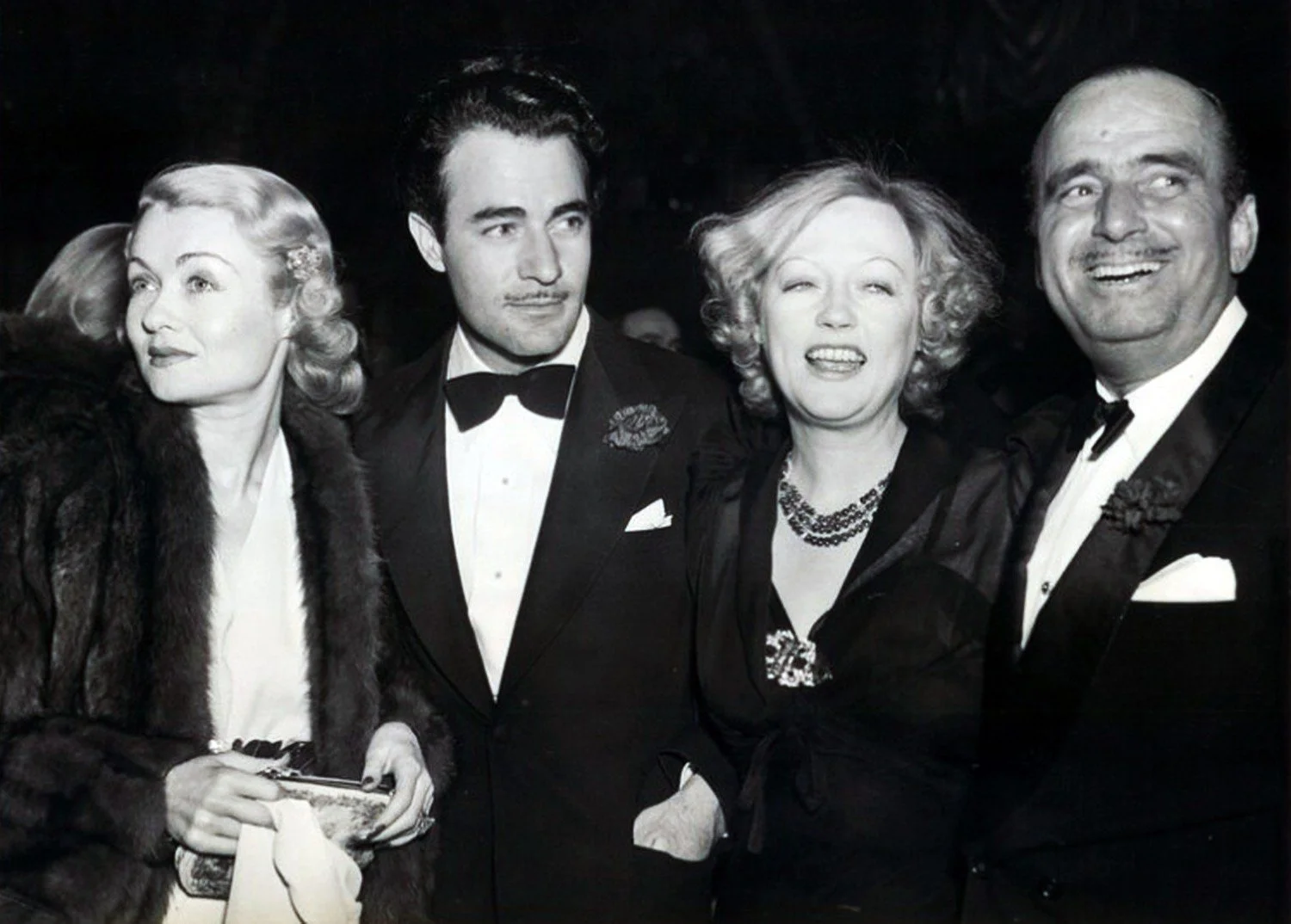
Constance Bennett, Gilbert Roland, Marion Davies and Douglas Fairbanks at the Cocoanut Grove
Davies was one of Hollywood’s greatest and most popular party givers; an invitation to one of her soirées was recognition that you had really made it in Screenland. Always looking for a reason to celebrate and an excuse for a cocktail, she hosted a party at the Ambassador Hotel for Charles A. Lindbergh in celebration of his 1927 solo non-stop flight across the Atlantic Ocean from New York to Paris, France.
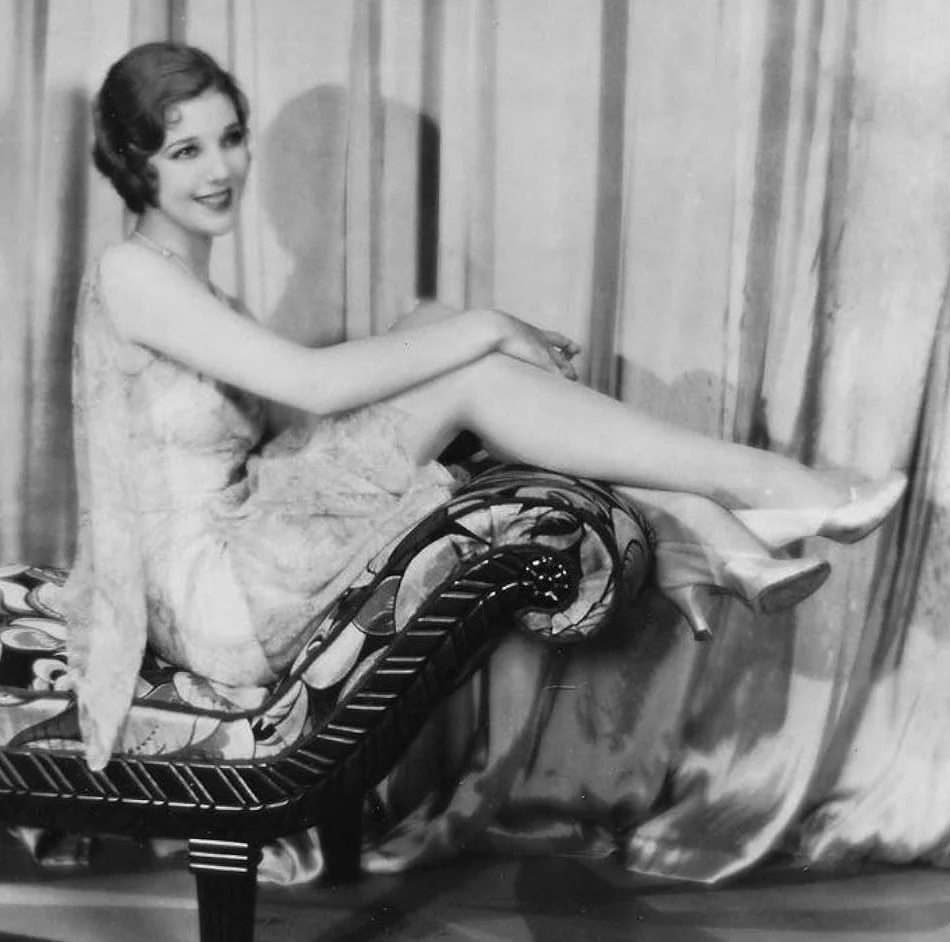
Loretta Young was a good dancer and got lots of attention
The Cocoanut Grove hosted a series of Friday night dance contests that included the participation of Gloria Swanson, Mary Pickford, Joan Bennett, her sister Constance Bennett, Dorothy Lamour and Loretta Young.
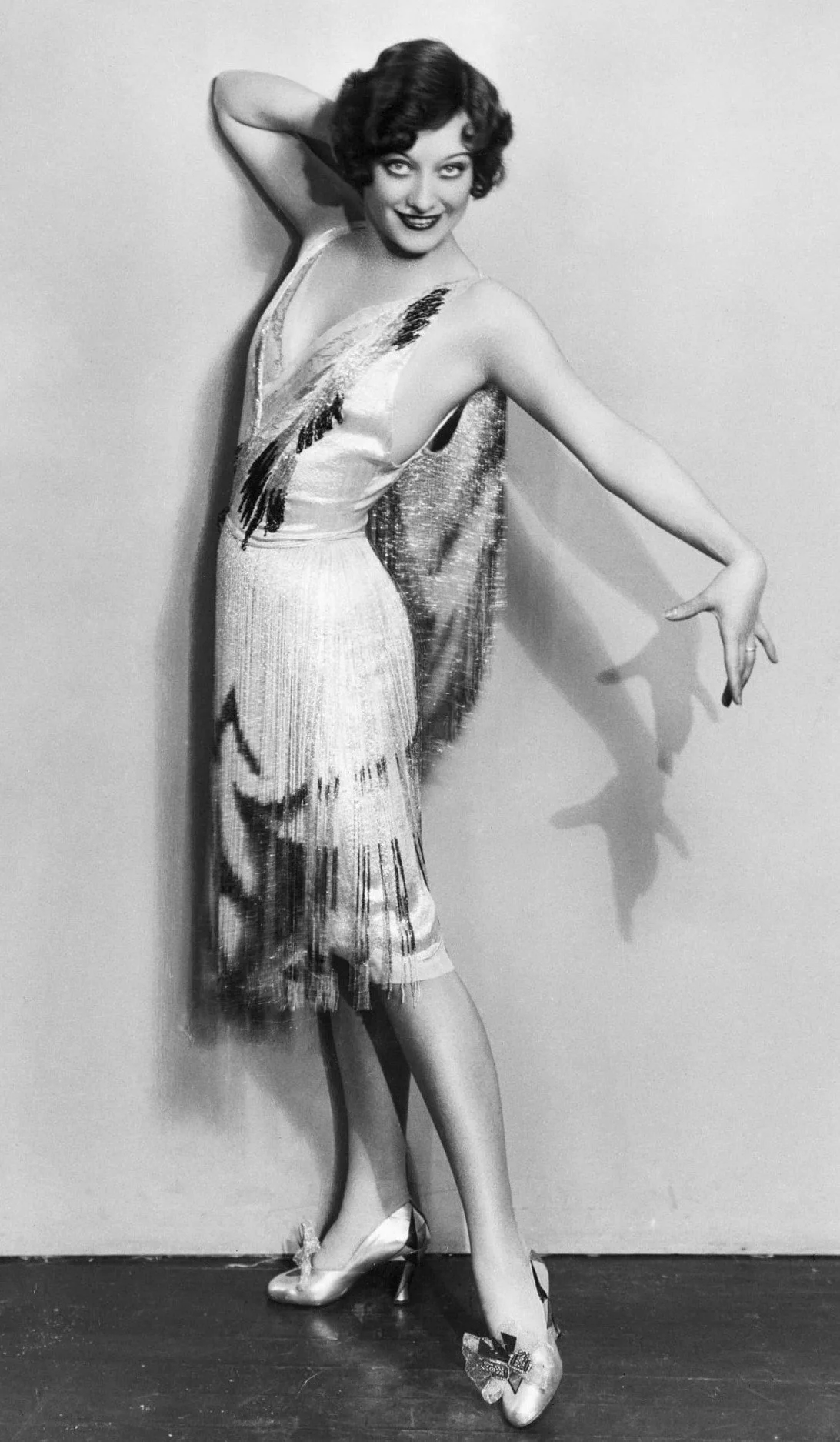
Dance Queen Joan Crawford strikes a pose
Winning most often was a young and energetic go-getter. Her success and notoriety there as the Grove’s certified dance Queen would lead to a contract with M-G-M Studios and a new name, Joan Crawford. Her stellar talents on the dance floor were remembered by many, including a famous ex-husband, Douglas Fairbanks Jr. He had fond memories of those exciting evenings.
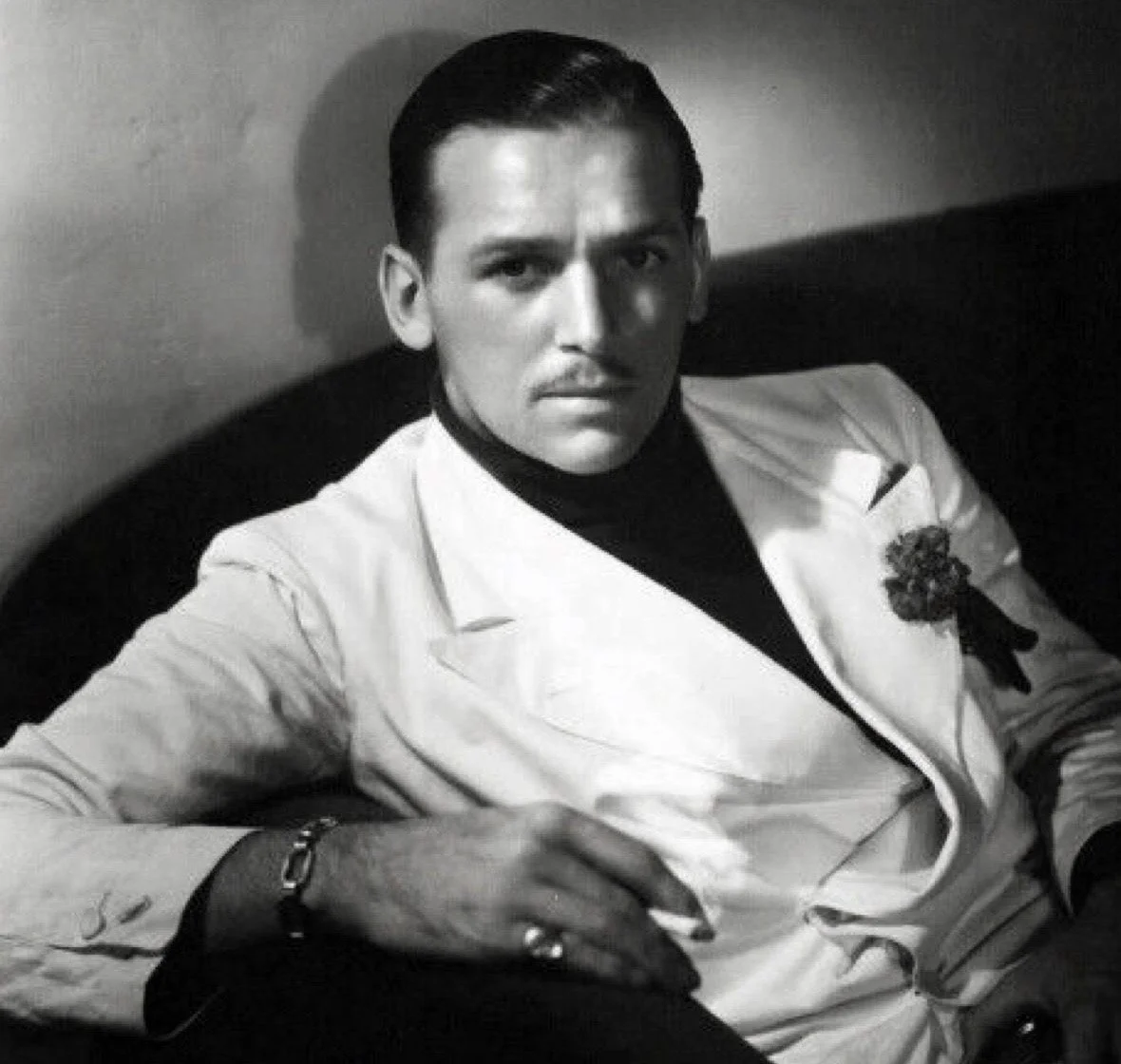
Douglas Fairbanks Jr.
“For the special “inside” group of Los Angeles jeunesse d’or, the thing to do on a Friday night was to compete in the dancing contests at the Cocoanut Grove. The orchestras were world famous—Fred Warning, Paul Whiteman, and others—the best and biggest. I usually took Cousin Flobe and we did marvelously well together—actually winning two or three times, and we almost always got a second or third prize. Our chief competitors were Tommy Lee, the smooth, elegant son of the owner of the local Cadillac franchise, Sally (Young) Blane, Mike Cudahy, the heavy-drinking, meat-packing heir and one of my backlot ball-playing pals. There was also his striking girlfriend, the young MGM dancer “find,” Joan Crawford, of whom the press predicted we would hear more in time. It proved to be one of their accurate prophecies. … In fact, when Flobe and I entered the Friday night dance contests at the Cocoanut Grove, it was often Joan and Mike, both superb dancers, who won first prize.”
Hedda Hopper was often there in the audience.
“When Joan first came to Hollywood from New York, where she’d been a dancer, the only place to display her abilities was the Cocoanut Grove in the Ambassador Hotel. Friday night was college night; the Black Bottom and the Charleston were the rage. Everything shook at the Grove, keeping company with the monkeys and the cocoanuts in the palm trees. I saw Joan win first prize week after week—a silver loving cup. She won so many of the things that if she’d melted them down she could have upped the price of silver.”
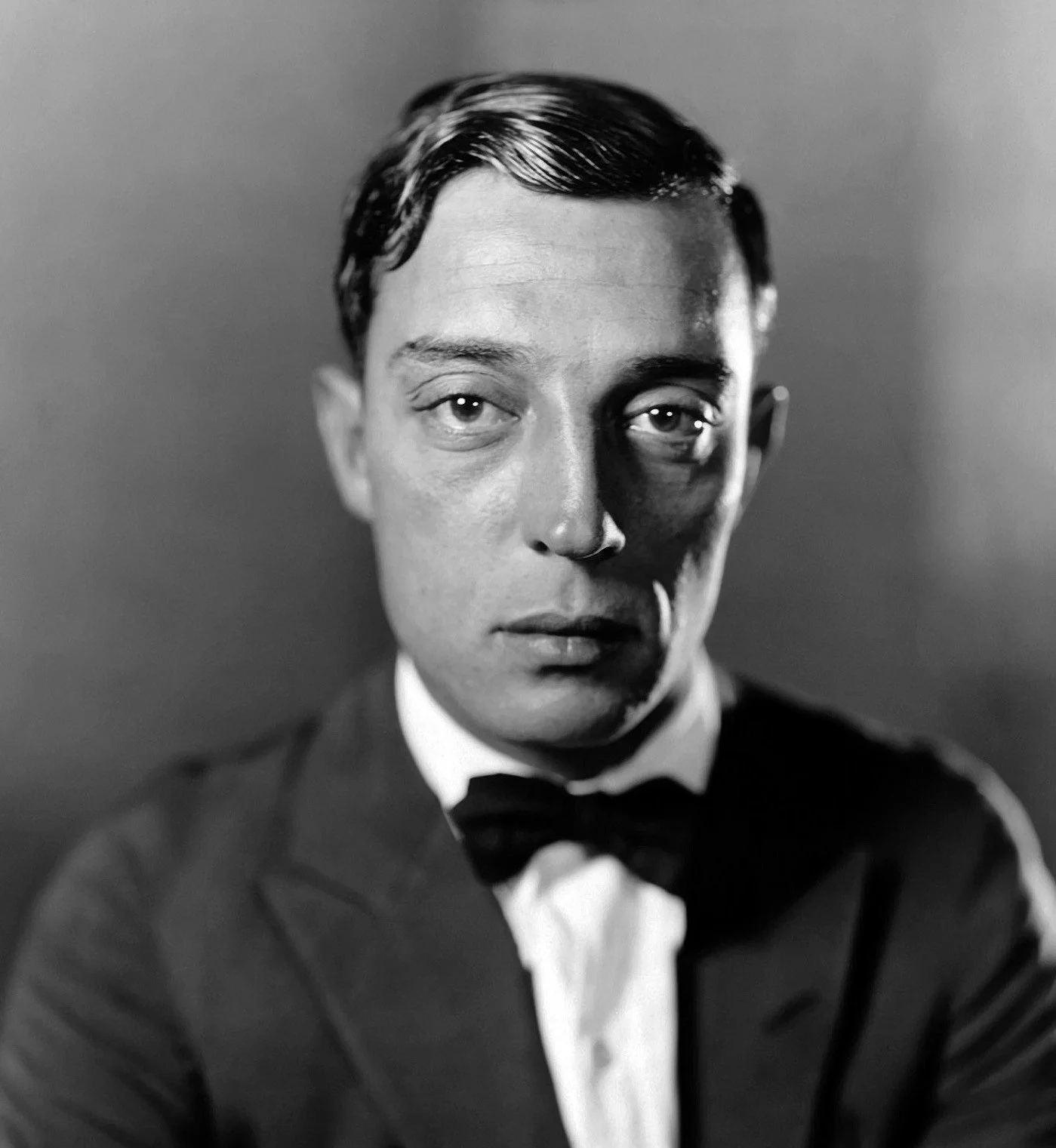
Buster Keaton
Silent Star Buster Keaton fondly remembered those nights as well.
“In 1921, a night spot was opened in Los Angeles and soon became the place to see and be seen. Opened by the Ambassador Hotel and christened the Cocoanut Grove, the café became the mecca for stars and movie executives as well as tourists looking for stars and executives. As the story goes, many stars were discovered by producers while dancing there. Among them, I hear, were Joan Crawford, Carole Lombard, Loretta Young and Ricardo Cortez. If you can keep a secret, it was Keaton, himself, who waltzed with Crawford, pinned an orchid on Lombard, sang off-key choruses with Young while the band played, then gave up his table so Cortez could be amped by a producer.”
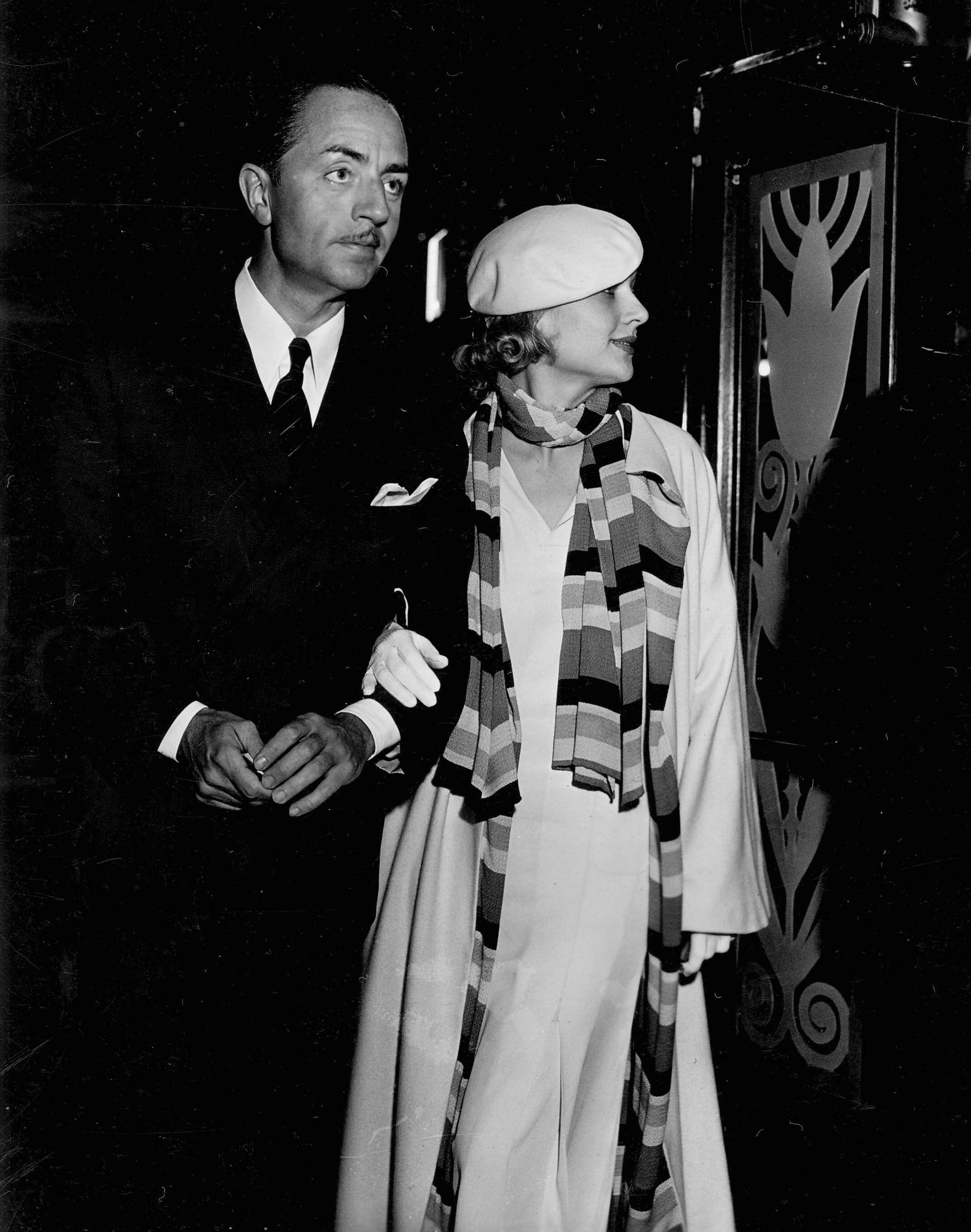
William Powell and Carol Lombard arrive at the Cocoanut Grove
Jane Peters gave Crawford a run for her money on the dance floor. She would go on to become a very popular actress and wife to William Powell and Clark Gable, albeit with a new name, Carole Lombard.
“I went through the jazz-mad age with a vengeance, and spent almost every night dancing at the Cocoanut Grove. Dancing was all I thought of, and to be a superb dancer was the tops in my estimation. I’d have laughed at the idea of becoming a mere dramatic actress! It took me years to live down my reputation of being “the Charleston Kid’.
Hollywood legend claims the 16-year-old Lombard was discovered here by a Fox studio talent scout which led to a screen test.
And it wasn’t just the ladies that got discovered there. Motion picture industry pioneer Jesse Lasky always had a roving eye for potential talent. He found it while dining with his wife.
“One night in 1924 Bessie and I were dining with Margaret Miller and some other friends at the Ambassador Hotel, watching the amazing dance contest, which, as a concession to the current craze for such exhibitions, was a Friday-night feature at the Cocoanut Grove. The women were captivated by one dancer in particular, a handsome young man with a Latin look, identified by the number 19 on his back. They chattered about his charm and rooted for his victory all through the contest. The other women in the room evidently experienced the same fluttery feminine feelings, for when the prize winners were decided by applause, No. 19 and his partner got a deafening ovation. Partly to give the ladies at my table a thrill and partly with the thought that a nation of women might be susceptible to the same thrill, I asked the waiter to tell “No. 19” that we would like to meet him. Learning that his name was Jack Crane and that he wouldn’t be averse to a picture offer, I asked him to see me at the studio the next day.”
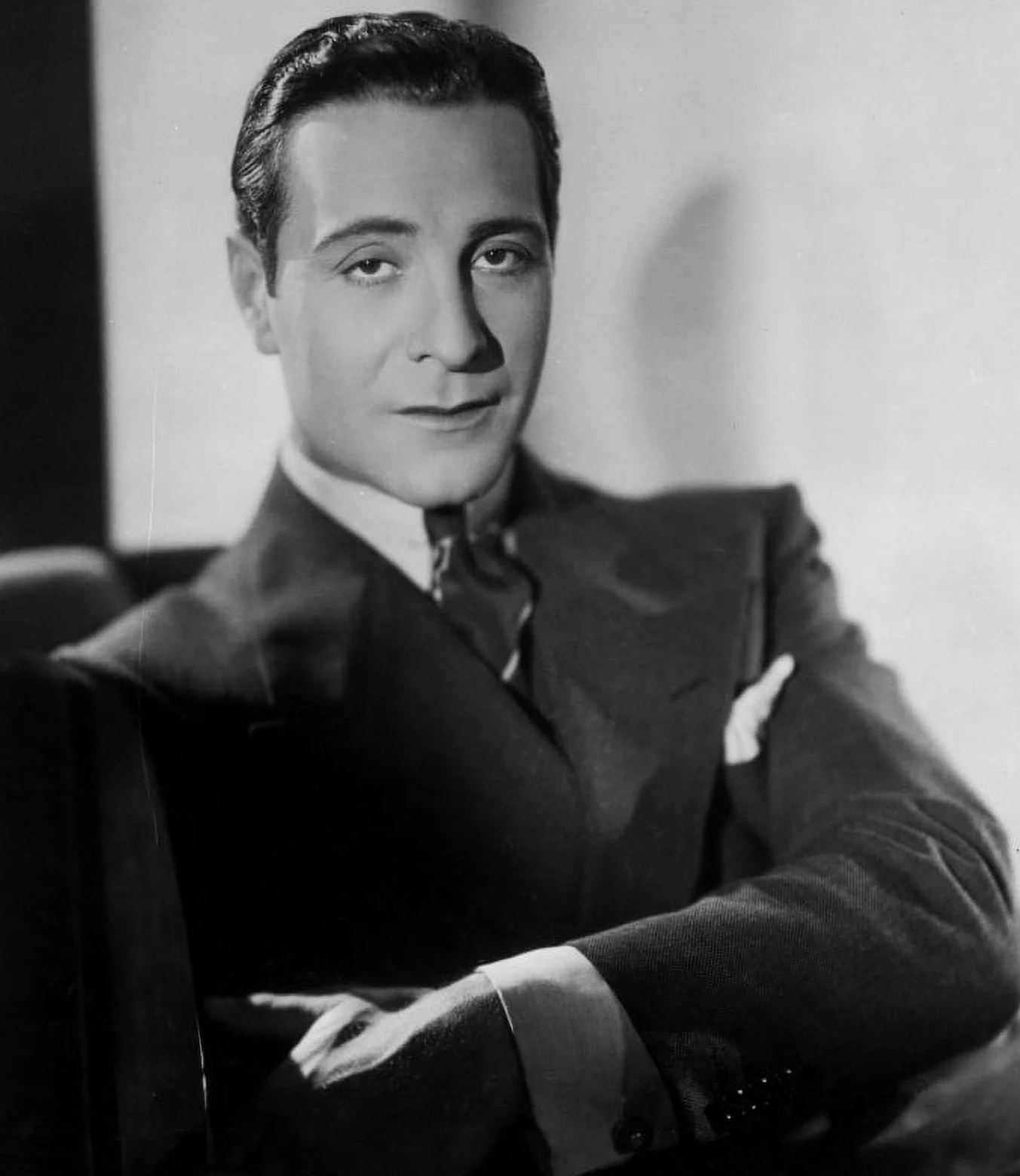
Ricardo Cortez
Crane gladly took up the offer and at the studio learned that Jesse Lasky was looking for a new Valentino type. However, the name Jack Crane was not the name for a sexy Latin lover. It had to be changed, and with little effort, it was. Jack Crane became Ricardo Cortez, and although he was never a threat to the Valentino legacy, he went on to have a respectable career in show business.
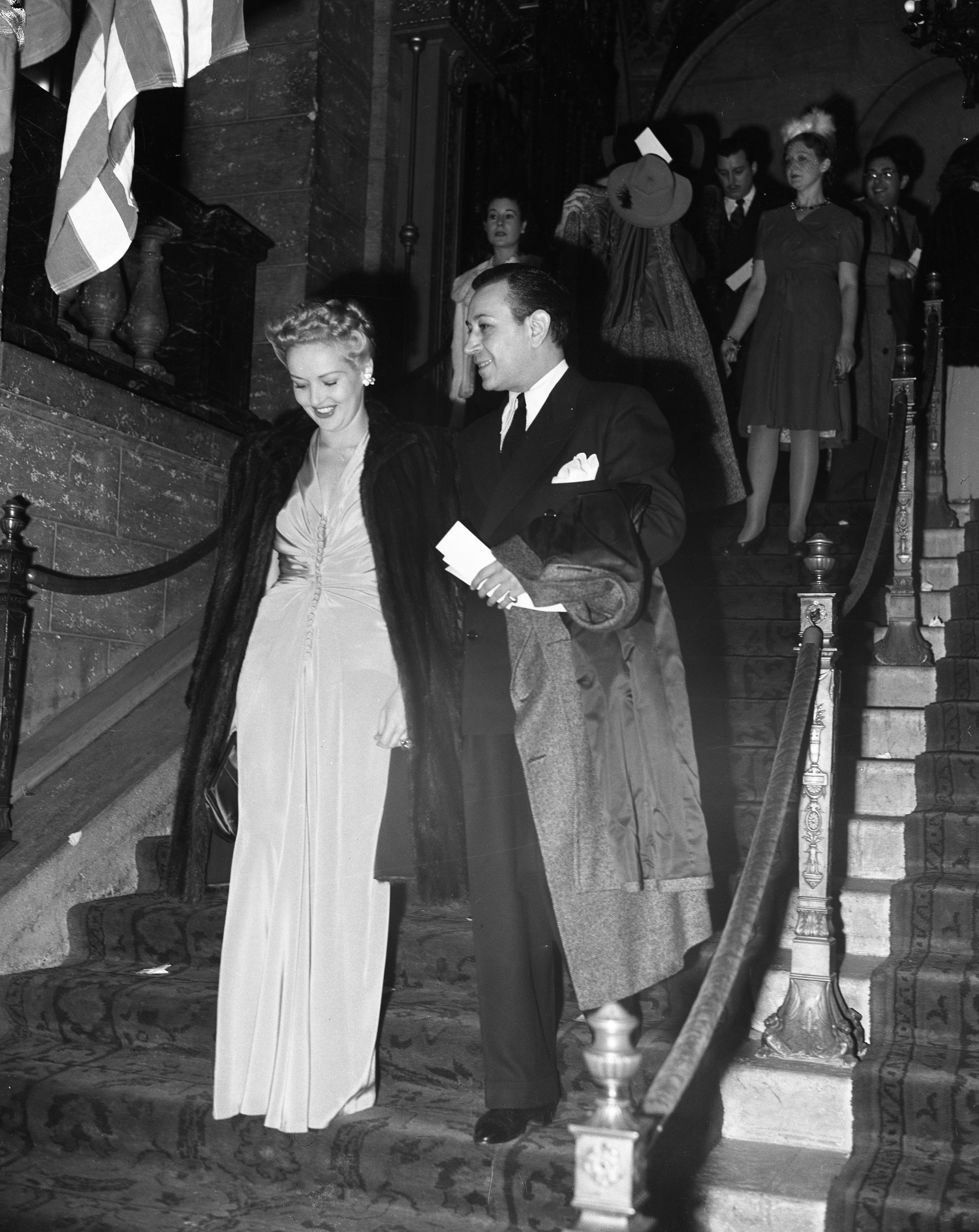
Betty Grable and George Raft make a grand entrance to the Cocoanut Grove
George Raft impressed many with his fancy footwork on the dance floor, often with Norma Shearer or Ginger Rogers. Raft was a professional, sometimes referred to as “The World’s Fastest Dancer” during his early days in New York. There he was attracting capacity crowds at the Mob friendly El Fey Club, making $150.00 a week.
One audience member there, a guy named Fred Astaire, was admittedly impressed.
“I went there several times to see George dance…He was a sensation in those days and we went especially to see George. The El Fey Club was the “in” place to go…George did the fastest, and most exciting, Charleston I ever saw. I thought he was an extraordinary dancer…” Having Fred Astaire compliment you on your dancing skills is the quintessential definition of the phrase, “High praise from Cesar.”
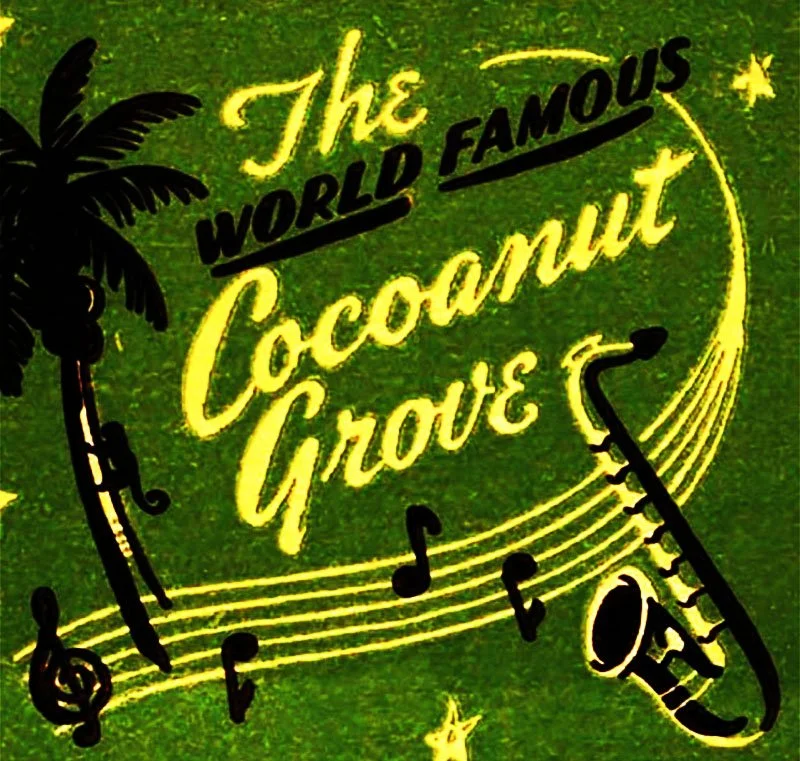
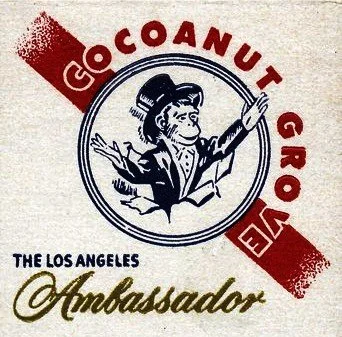
Cocoanut Grove matchbook covers
Singer and songwriter Pink Tomlin frequently brought visiting guests to impress. “This club was the current “in” place, usually overflowing with celebrities. The food at the Grove was good, the music mellow, and the atmosphere free of autograph hunters. Show people weren’t bothered unless they arranged it themselves. The place was always jammed. Evidently stars felt there was safety in numbers. The music at the Cocoanut Grove was provided by such pros as Eddie Duchin, Guy Lombardo, and Freddy Martin.”

Gus Arnheim and his Cocoanut Grove Ambassadors
The Cocoanut Grove was the epicenter for popular big band music, where the formally attired patrons would ballroom dance to the music of the famous name bands of the era. Playing to packed crowds were, Gus Arnheim and His Cocoanut Grove Ambassadors featuring crooner Russ Columbo, Rudy Vallée and the Connecticut Yankees, Abe Lyman’s All-Star Orchestra, The Phil Harris Orchestra, Ozzie Nelson and his Orchestra, Ray West and The Cocoanut Grove Orchestra, Carlos Molina and his Famous Cocoanut Grove Tango and Rumba Orchestra. The intoxicating music attracted great dancers like Bebe Daniels, dancing to “Rose Room Tango” with Rudolph Valentino with many others dancing the night away.
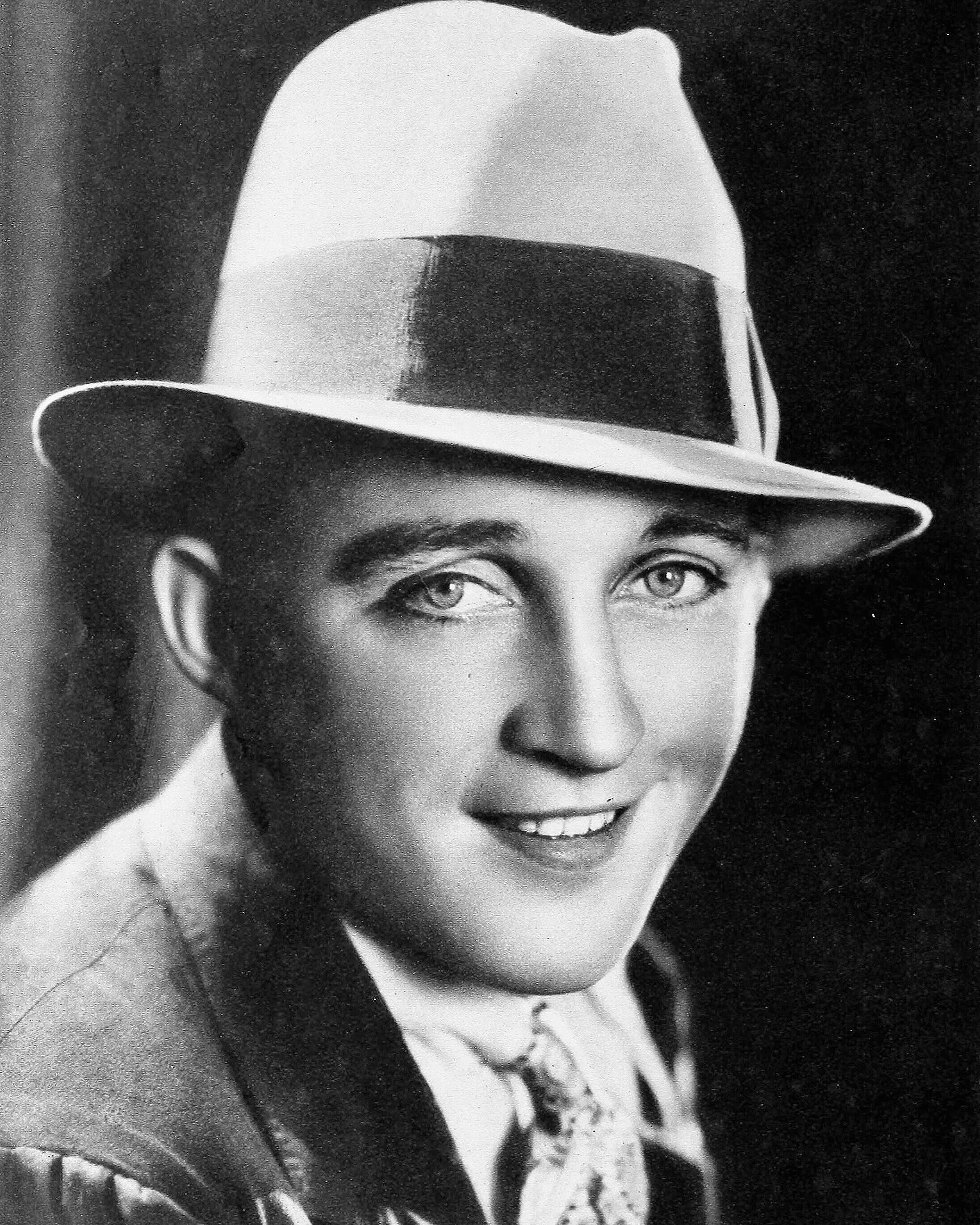
Bing Crosby’s solo singing career started at the Cocoanut Grove
The Rhythm Boys, featuring a young Bing Crosby, achieved a new level of success with their performances carried on the in-house radio station, broadcast nightly from 10pm to midnight on the Pacific Coast network. Crosby remembered the impact the program had on the young singer’s career.
“The Grove had a radio outlet two hours each night. We thought this a fine thing, but we had no conception of how wonderful it actually was. Through this new medium, we built popularity, all over California and as far north as Seattle, Portland and Tacoma. I found out later that even some of the people in the Midwest used to sit up until 3 a.m. to catch us.”
And more than a handful of times the young crooner, himself an enthusiastic social drinker, would have to take a taxi home long after the evening show had ended.
Crosby’s success would resonate with his fans for decades.
“I’m always being asked to sing songs I sang at the Coconut Grove more than twenty years ago. Probably those who make the requests romanced their wives there before they were married and the songs they heard at the Grove recall those happy occasions,” he would later write in his autobiography, Call Me Lucky.
Lucky, indeed, considering that Mack Sennett, after witnessing Crosby’s command of his audience, signed him for a series of film shorts.
“What struck me about the guy was all the stuffed shirts at the Grove stopped dancing and gathered around the bandstand to watch him croon. They came to hear him night after night. He held ‘em.”
It was during his stint at the Cocoanut Grove that Crosby began to focus on a solo career and would meet his future bride, Dixie Lee. “I proposed to her over a plate of chicken in the Cocoanut Grove.”
Crosby was not alone; romance was in the air for many Grove patrons. It was at the Grove that future movie mogul, Darryl F. Zanuck, had his first date with actress Virginia Fox, a frequent co-star of Buster Keaton. Six months later, they were married. Jack Benny had his first date with future wife Mary Livingston there, a union that lasted 47 years.
Singer and composer Pinky Tomlin fondly remembered a 20th Century-Fox arranged date with his young co-star Rita Hayworth, promoting Paddy O’Day (1936). “The studio cooked up this scheme to get Rita, the film and me some publicity by making up a romance between us. They fixed for us to be seen at various hot spots, and furnished us with a nice car and a chauffeur. Of course, the first place we used to go to in those days was the Grove. They knew me there pretty well and pretty soon they were playing a couple of my songs and taking pictures of us while we made this regal sort of entrance down four or five steps and across to our table. I recall this so vividly because she was so damn gorgeous and photographed like a million dollars.”
This memorable evening and many others were captured on film by photographer Len Weissman, the in-house photographer for the Cocoanut Grove and the hat-shaped Brown Derby across the street. Like the army of photographers that haunted these Hollywood night spots, he supplied a constant stream of photos for the fan magazines, including Screenland and Motion Picture.
The Cocoanut Grove served as a site for the Academy Awards six times, including the memorable 1940 awards ceremony. That year the most popular motion picture of all time, Gone with the Wind was nominated in 13 categories. It won ten Oscars, including Best Picture, Vivian Leigh for Best Actress and Hattie McDaniel for Best Supporting Actress. When McDaniel’s name was announced as the winner, the crowd erupted with their approval. Columnist Louella Parsons reported in her column, “The ovation will go down in history as one of the greatest ever accorded any performer in the annals of the industry. En masse the entire audience, stars in every place, stood and cheered the beloved Hattie McDaniel.”
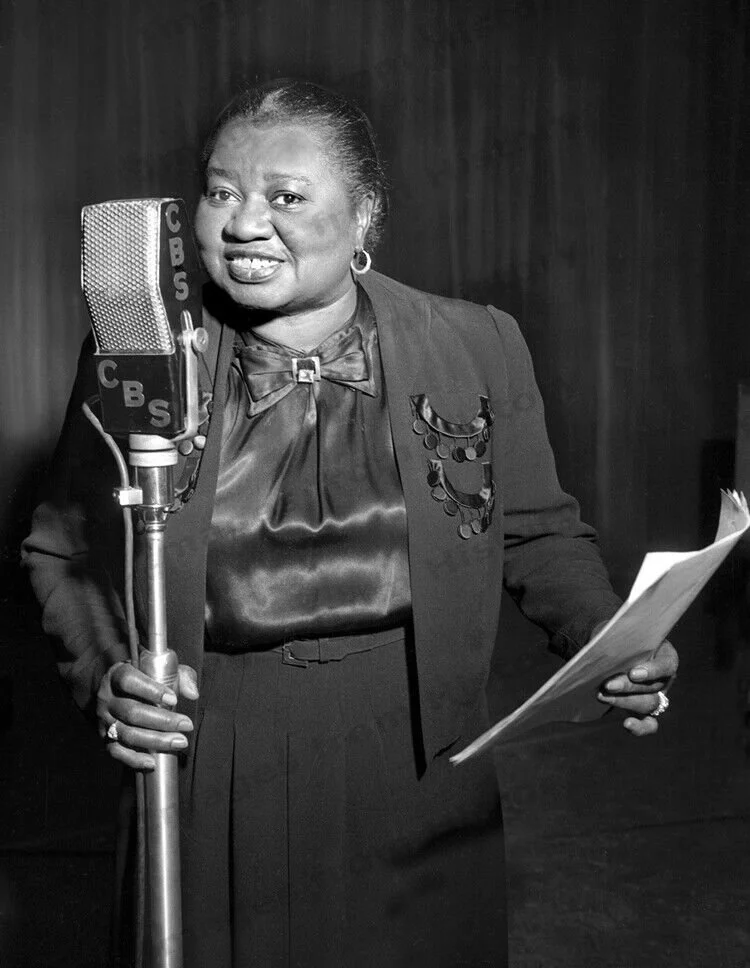
Hattie McDaniel won a Best Supporting Actress Oscar for her role in Gone with the Wind
The popular McDaniel was the first African-American to ever receive an Academy Award on that memorable evening. She later stated, “I shall never forget that night at the Ambassador when Fay Bainter so graciously presented me with the coveted award. It was one of those always-to-be-remembered nights. Everybody was shaking hands and congratulating me. It was like Old Home Week in Kansas.”
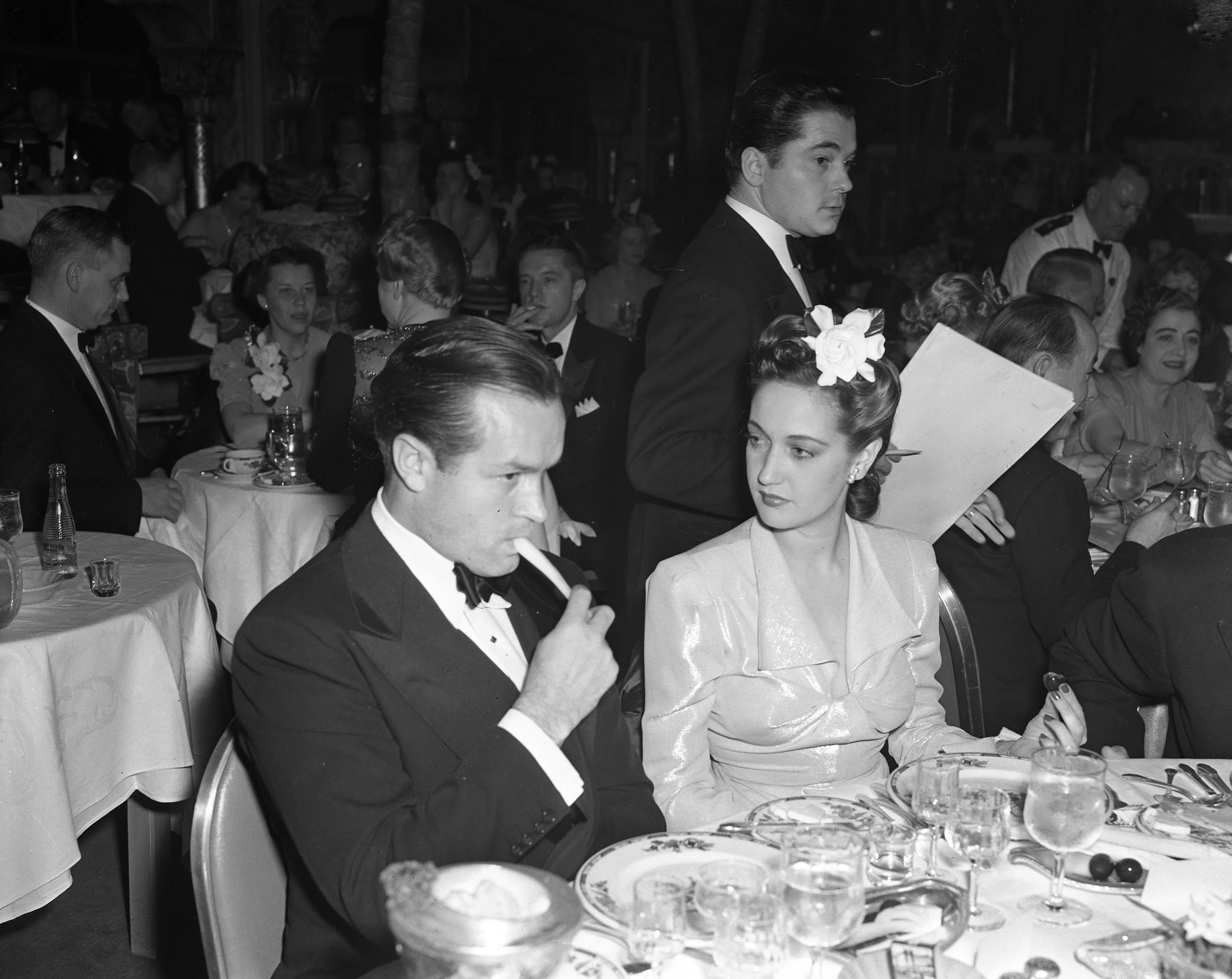
Bob Hope and Dorthy Lamour attend the 1940 Academy Awards banquet
In addition to the then record setting Oscar wins for a motion picture, David O. Selznick was presented with the Irving G. Thalberg Award as the year’s outstanding producer. This onslaught of awards caused the host, Bob Hope, to sum up the evening with a quip, “It’s a great thing--this benefit for David O. Selznick.” However, some of the evening’s excitement was slightly muted; in those days the Oscar winners were known in advance.
In 1941, the Cocoanut Grove was converted into an authentic Western setting for a Barn Dance, including bales of hay and wagon wheels for a country Hoedown honoring cowboy star Roy Rogers, celebrating his increasing clout at the movie box-office.
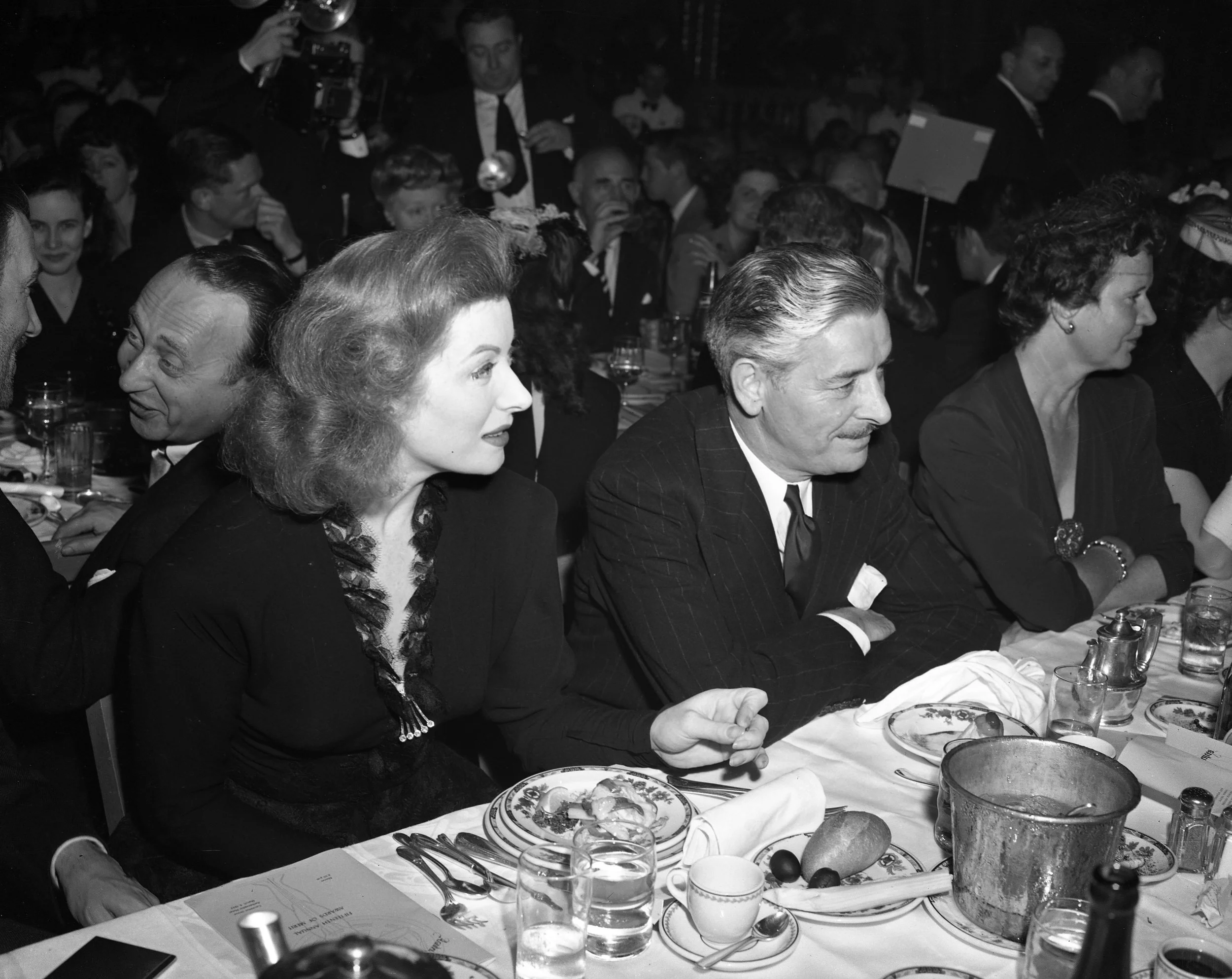
Greer Garson and Ronald Coleman attend the 1943 Academy Awards at the Cocoanut Grove
In 1943, the Academy Awards were presented at the Grove for the last time. That year actress Greer Garson won a well-deserved Best Actress Oscar for Mrs. Miniver. Hollywood legend had her acceptance speech rambling on for forty minutes, the longest in Oscar history. In reality her heartfelt words lasted less than eight. Why the obvious discrepancy? Never overlook the jealousy factor and sour grapes in Hollywood, one of the few things that has never changed.
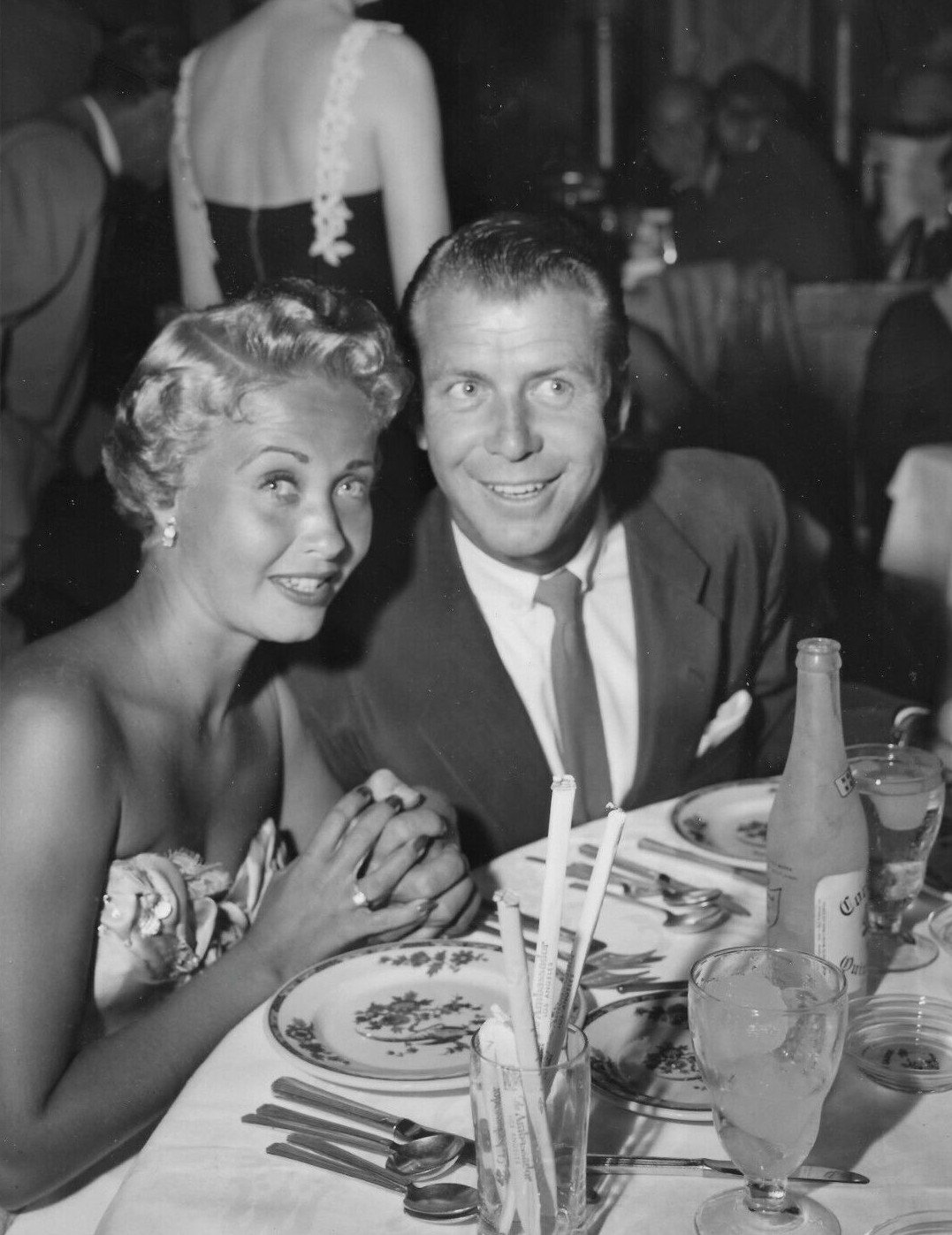
Friends Jane Powell and Gene Nelson at a Cocoanut Grove soiree
Jane Powell fondly remembered coming with her family in 1943. “Cocoanut Grove was the place to go in Hollywood then. It was like being on a movie set; it even had fake clouds blowing languidly across the ceiling. All the big acts played there, appearing amid the fake palm trees with fake monkeys dangling from them. When we first came to Hollywood, Mama and Daddy and I would go to the Cocoanut Grove for dinner on Sunday nights, and Daddy and I would dance—it was against the law to dance in a club until you were eighteen—but the Grove was different. It seemed like family.”
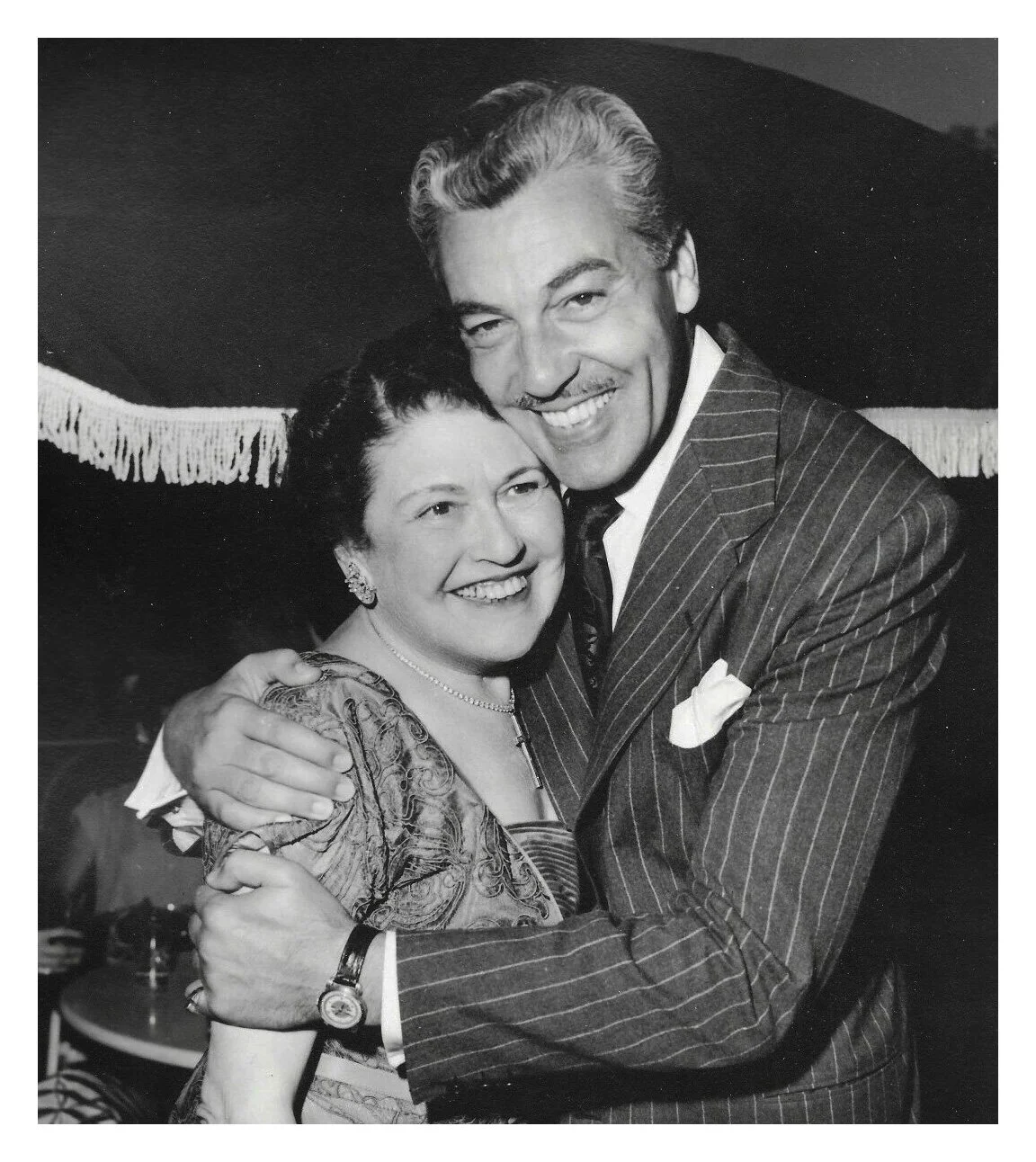
Gossip columnist Louella Parsons with Cesar Romero
In 1948, a Masquers Club testimonial dinner was held for media columnist Louella Parsons, celebrating her thirteenth anniversary of covering the motion picture industry. “The guest list was the Who’s Who of motion pictures, and even the oldest old-timer could not recall when so many reigning stewards of the past, present, and future, in toto, as well as agents, press agents, producers, directors, authors, distributors, studio chiefs, maîtres d’hôtel, the mayor, and the governor all got together in one room,” said The Daily Variety, summing up the tribute.
Eddie Cantor may have been speaking for many of the attendees when he confessed, “I am here for the same reason everybody is—we were afraid not to come.” Some of the other attendees who were “afraid not to come” included Greer Garson, Ronald Coleman, Claudette Colbert, Louis B. Mayer, Vincente Minnelli and Loretta Young.
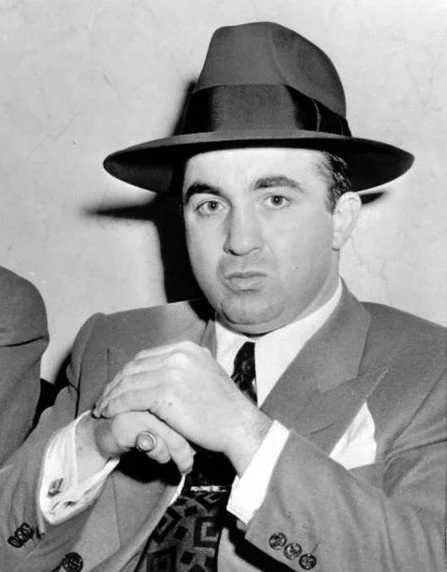
Los Angeles gangster Mickey Cohen loved the night life
The glamorous appeal of the Grove spilled over to LA’s notorious Underworld, including everyone’s favorite Hollywood Mob Boss, Mickey “I have killed no man that didn’t deserve killing in the first place” Cohen. He loved coming to the Cocoanut Grove to be seen and dole out to the staff his most generous tips, courtesy of his mostly ill-begotten gains. He claimed to have run gambling houses from some of the Ambassador’s exclusive suites.
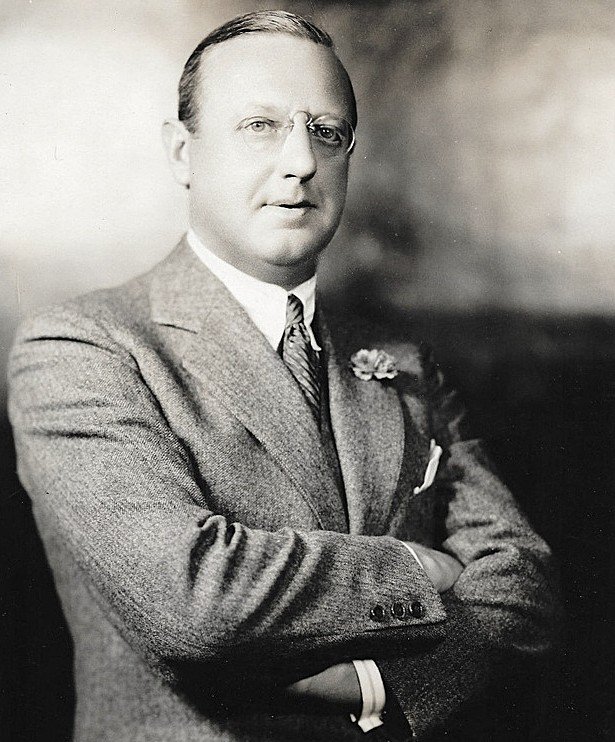
Jesse Lasky
On September 12, 1951, Jesse Lasky was honored by the Screen Producers Guild with the first annual “Milestone Award” with a silver wreath on the plaque inscribed: "To Jesse L. Lasky for his historic contribution to the American motion picture.” It was a most memorable night for Lasky, with long-time friends singing his praise, and expressing their admiration. Among the highlights for Lasky were the testimonials of fellow movie making pioneers. Lasky would later write about that evening with affection.
“Adolph Zukor recalling the beginnings of the company that became Paramount under our joint twenty-year stewardship, Sam Goldwyn and Cecil DeMille acknowledging that I started them in the picture business as partners in the company that bore my name, Gloria Swanson and Mary Pickford referring to my influence in their lives and careers as employer and dear friend…”
Over the years the nightclub was promoted by the media in multiple ways. Radio listeners could hear the Cocoanut Grove Orchestra at home with a weekly evening radio broadcast on KNX Radio. Countless mentions in movies, magazines, and newspapers keep the Cocoanut Grove in the minds of the public.
Movie goers were very familiar with the swank nightclub as it was featured in many Hollywood themed screenplays. Some examples include M-G-M’s Bombshell (1933) starring Jean Harlow, an M-G-M short subject Star Night at the Coconut Grove (1934), Starlit Days at the Lido (1935), the Warner Bros. cartoon The Coo-Coo Nut Grove (1936), and in Columbia Pictures’ short subject Screen Snapshots (1937). The following year it was featured in the opening montage of Hollywood for Hollywood Hotel (1937) and it was the setting for Paramount’s feature film, Coconut Grove (1938), although the tony venue was all recreated on a studio sound stage.
An illustration of the Cocoanut Grove was used in the opening credit sequence of Abbott and Costello in Hollywood (1945) and it was prominently featured in the 1954 re-make of A Star Is Born.
For over six decades the eclectic headline entertainment to grace the Cocoanut Grove stage would include Fanny Brice, the aforementioned W.C. Fields, Eddie Cantor, Nat “King” Cole, Harry Belafonte, Johnny Mathis, Barbara Streisand, and Peggy Lee.
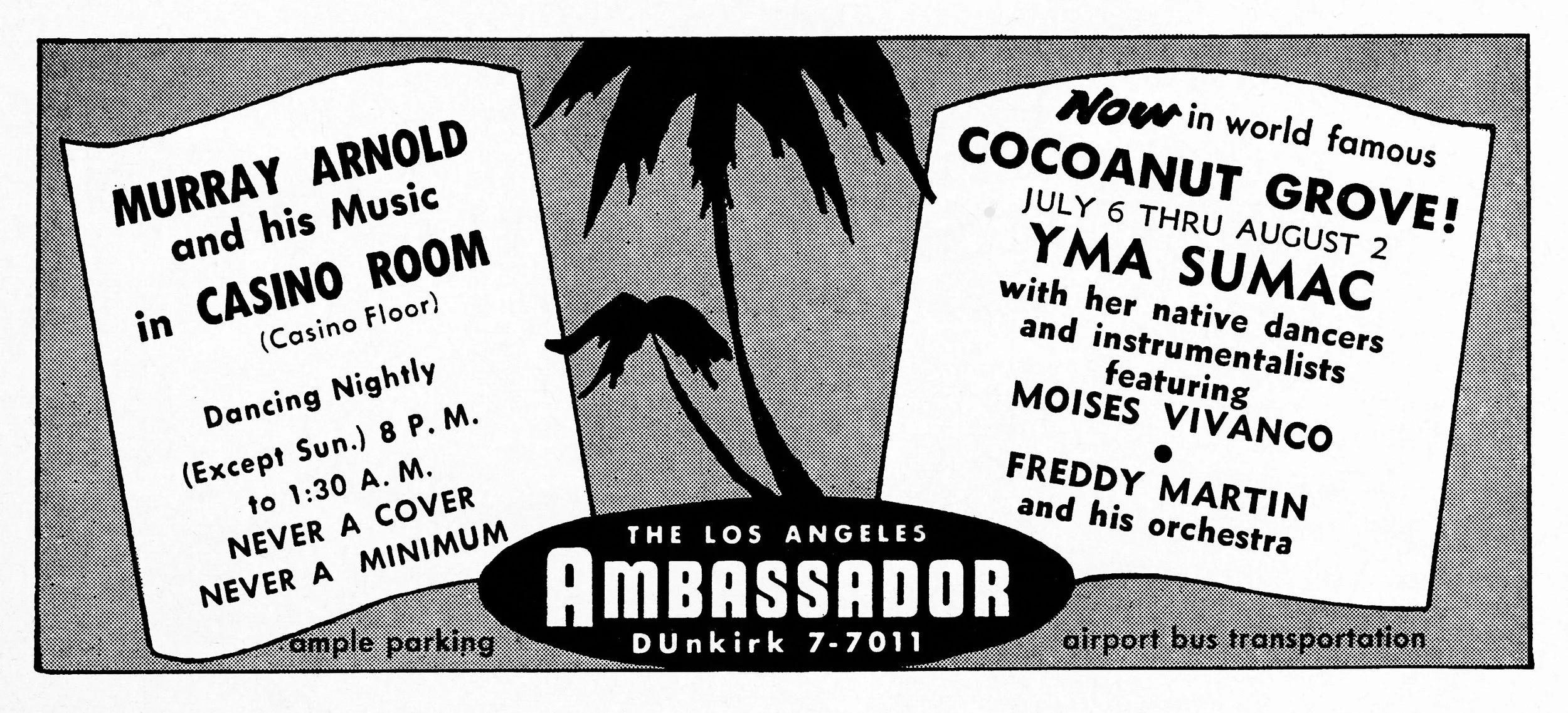
But one particular performance may have received the most media coverage. On the evening of November 14, 1953 Eartha Kitt’s career was given an unintended boost and in a way she would never have imagined.
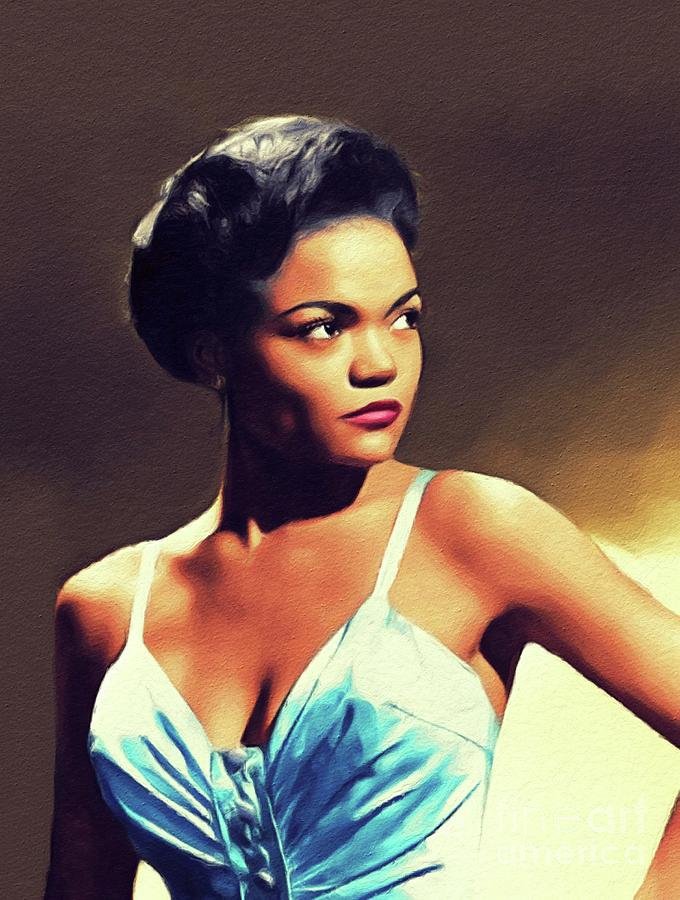
The “controversial” Eartha Kitt
“While I was appearing at the Mocambo, I was asked by the head of a committee to participate in a star-studded benefit to be given by mayor Paulson of Los Angeles in honor of the King and Queen of Greece. The event was to be held at the Ambassador Hotel’s Cocoanut Grove, and I felt honored to be asked. ‘Which songs do you want me to sing?’ ‘Oh, ‘Santa Baby,’ ‘C’est Si Bon,’ ‘Evil’—anything you are known for will be fine,’ I was told. Conscious that I would be appearing before royalty, I purposefully chose a tasteful and conservative gown to wear for the event. A car was sent for me and I was escorted by my accompanist, Arthur Siegel. We sat with June Allyson and Dick Powell. When the dinner was over, the drum rolled and Harry James came out to lead the orchestra as Dick Powell walked to the microphone. Then, because it was nearing my show time at the club, he introduced me.
He made my spirit soar when he said, ‘One of our great artists, Miss Eartha Kitt.’ June Allyson looked at me with the kind of warmth that only she has, and it put me completely at ease as I sang my first song, “I Want to Be Evil.” I was startled by the burst of applause when the song ended. I had expected the audience to be reserved because of our royal guests. My second song, “Santa Baby,” was received with more of the same. I did Duke Ellington’s “Blues” and ended with “C’est Si Bon.” I said goodnight to June and waved to Dick as I fled the room to my paying audience waiting at the Mocambo.”
Kitt was justifiably shocked by the negative fallout following the charity benefit. Apparently, Mayor Paulson had been offended, outraged and embarrassed by the “risqué” lyrics of her songs and even went so far as to accuse her of being “Un-American”. She was quoted as saying, “I can’t understand it. I’m just an innocent little girl. I didn’t think it was possible to shock politicians.” Fortunately, Hollywood quickly rallied to her defense but the tempest in a teapot lingered on. There was however, an upside. All the ongoing publicity, good and bad, was worth a fortune. If someone had not known who Eartha Kitt was before, they certainly did now. In an ironic twist, Kitt later received a telegram from the royal couple that read: “We don’t know what all the fuss is about. We thoroughly enjoyed the show.”
During their brief marriage, Rock Hudson and Phyllis Gates attended the shows there and then hit the dance floor. “Rock and I used to love attending the openings at the Cocoanut Grove of performers like Lena Horn and Harry Belafonte. Most of all, we enjoyed dancing to Freddie Martin’s romantic music.”
Martin’s long association with the Cocoanut Grove earned him the high honor of having a cocktail named after him, the Freddie Martin Frosted Daiquiri.
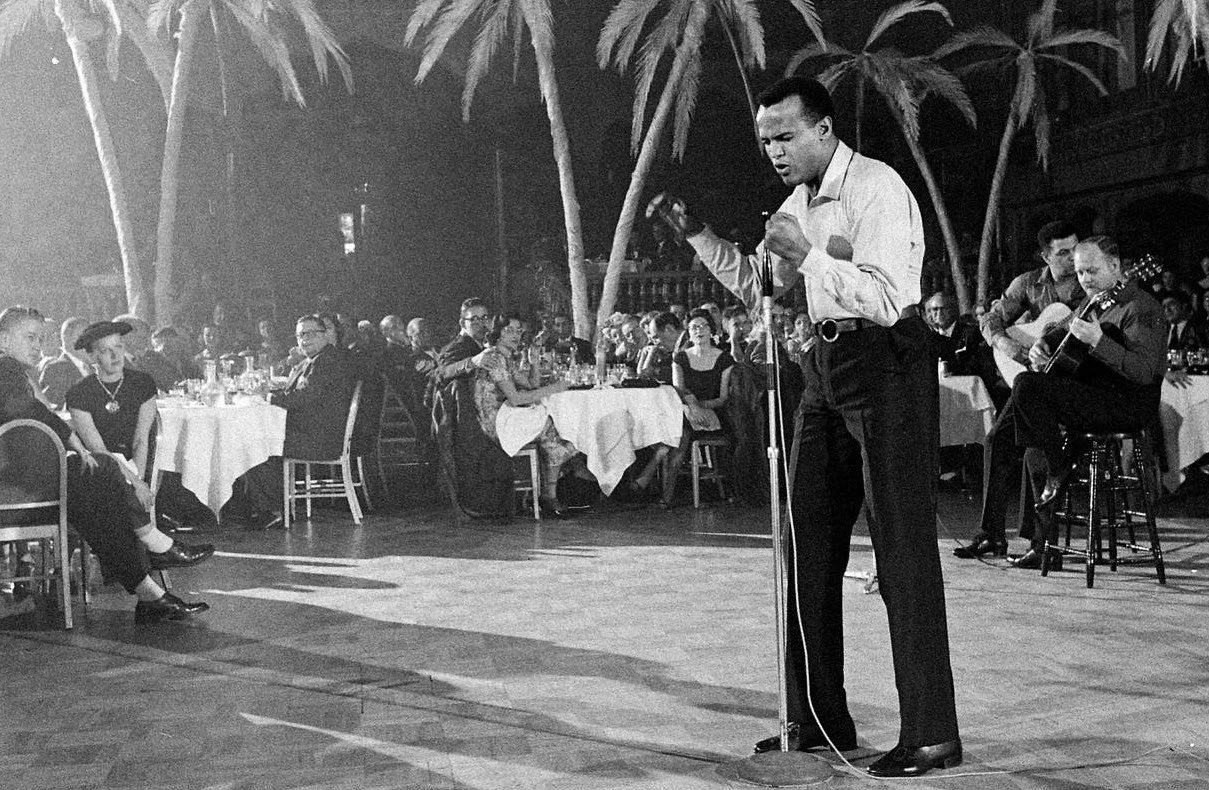
Harry Belafonte was a sensation when he opened at the Cocoanut Grove
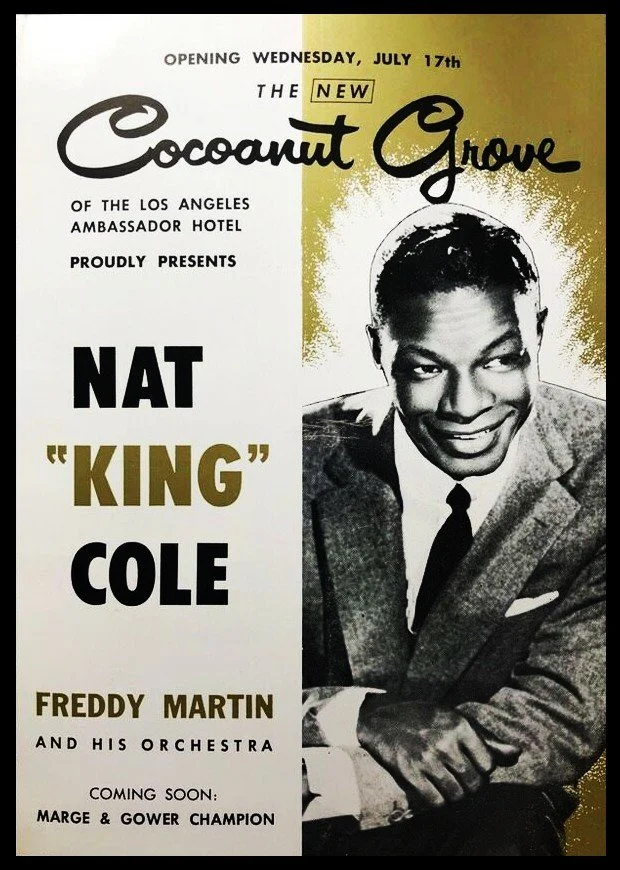
Nat “King” Cole plays the Cocoanut Grove
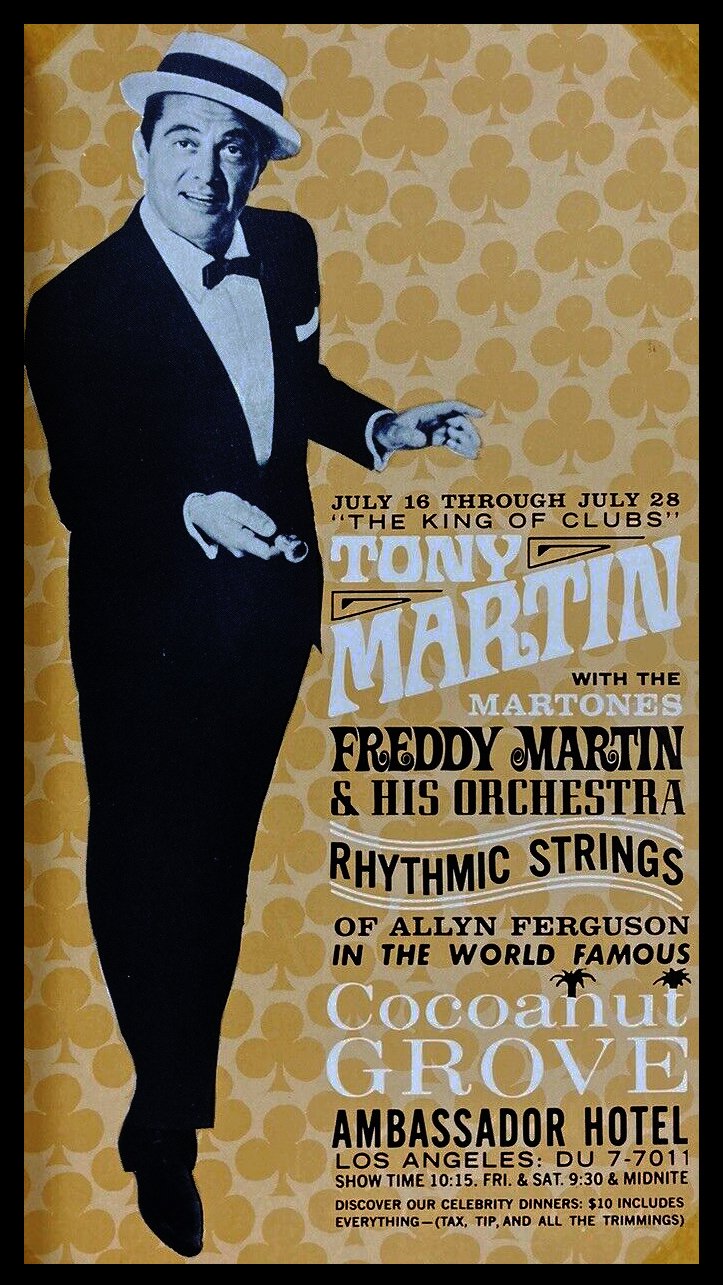
Tony “The King of the Clubs” Martin plays the Cocoanut Grove
Over the decades frequent patrons of the Cocoanut Grove would include Norma Shearer, Irving Thalberg, Bette Davis, William Powell, Jean Harlow, Clark Gable, Marlene Dietrich, Cary Grant, Cesar Romero, Robert Montgomery, Hedy Lamarr, Ginger Rogers, Ava Gardner, Desi Arnaz, Lucille Ball, Mike Todd, Rita Hayworth, Victor Mature, Edward G. Robinson, May Britt and Steve McQueen.
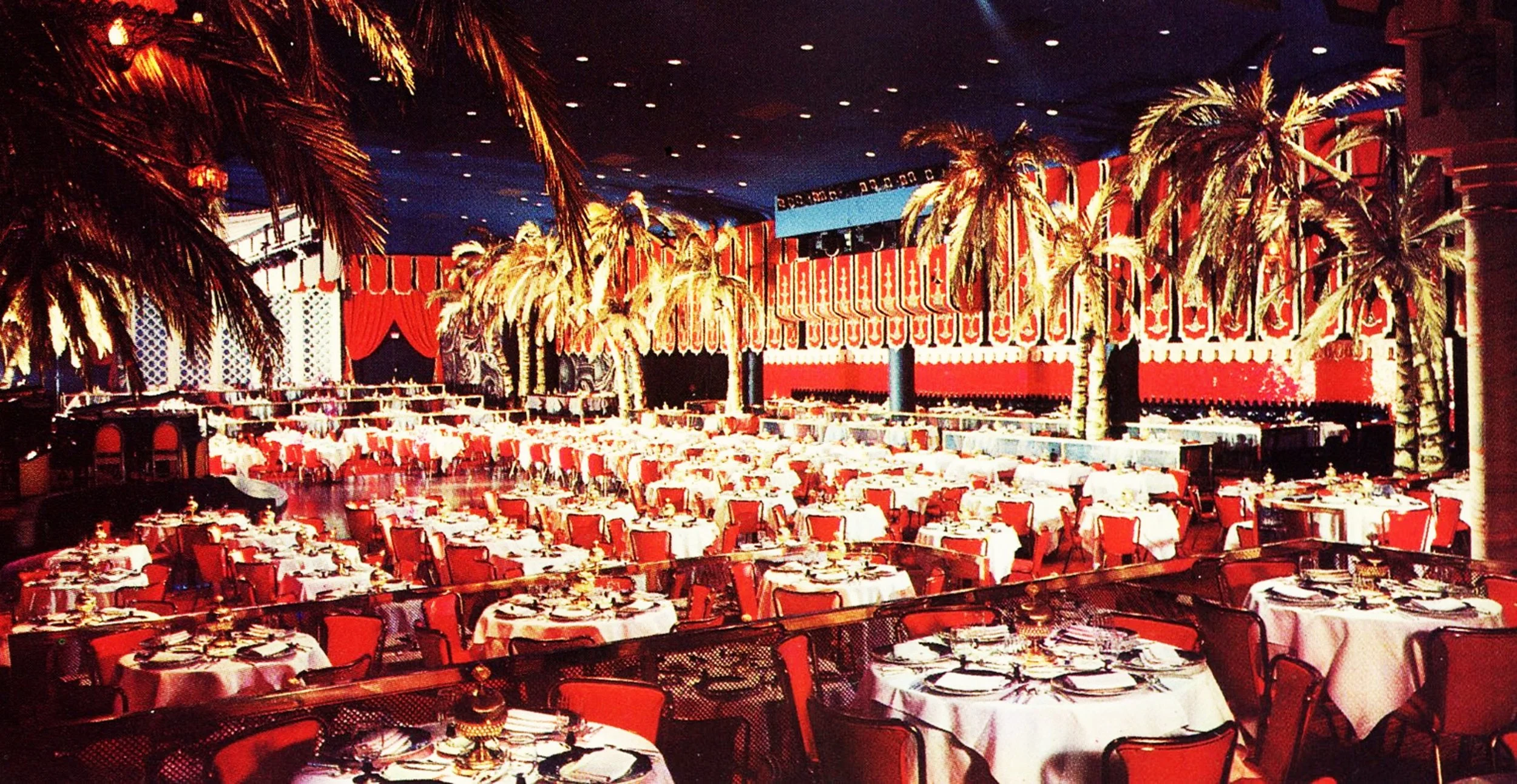
The Cocoanut Grove after a $750,000.00 modernization in 1957
However, despite the heavy media exposure and popularity, by the late 1950’s the crowds had begun to thin. To counter this, the Cocoanut Grove underwent a well-publicized $750,000 “modernized” renovation in 1957. Attending the opening of the new and improved Cocoanut Grove were silent stars Mae Murray and Francis X. Bushman, Gary Cooper, Fred Astaire, Groucho Marx and newcomers Sophia Loren, Jane Mansfield and Jack Lemmon. That same year the Cocoanut Grove embraced the popular Hawaii craze of the times and had “A Night in Hawaii” with island inspired food and entertainment on Tuesday nights.
The re-imagined venue would host other future rebirths. In August of 1958, Judy Garland’s triumphant two week “comeback” concerts were staged there and most of Hollywood turned out to cheer her on, Dean Martin and Jerry Lewis helped to lead the standing ovations.
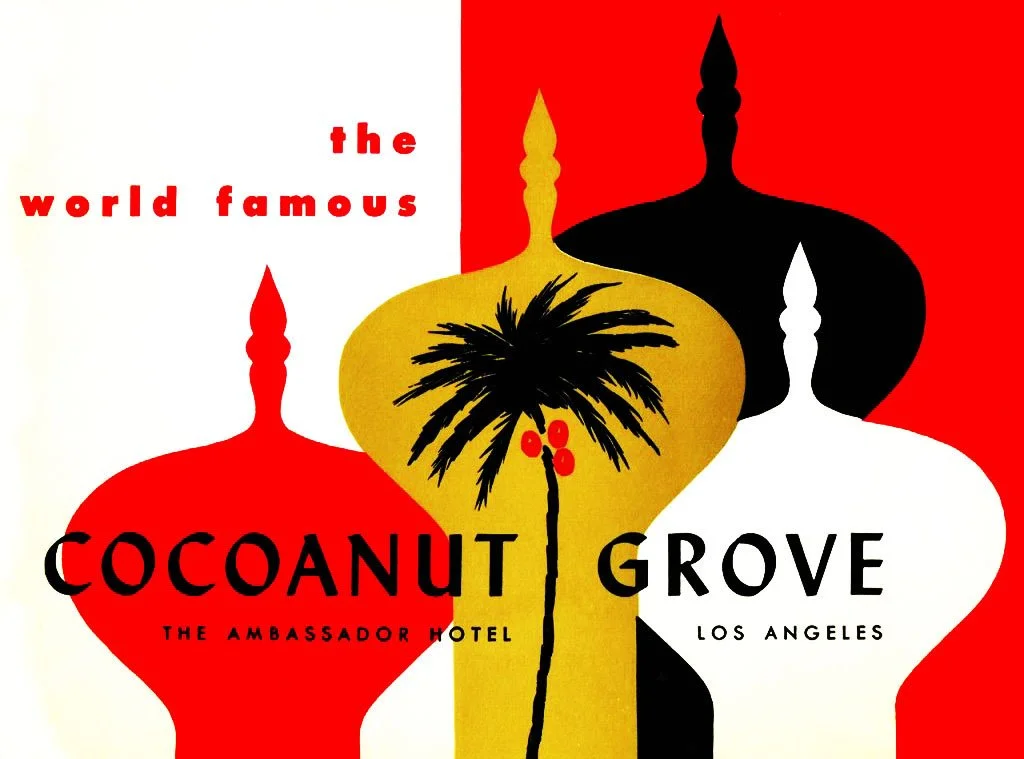
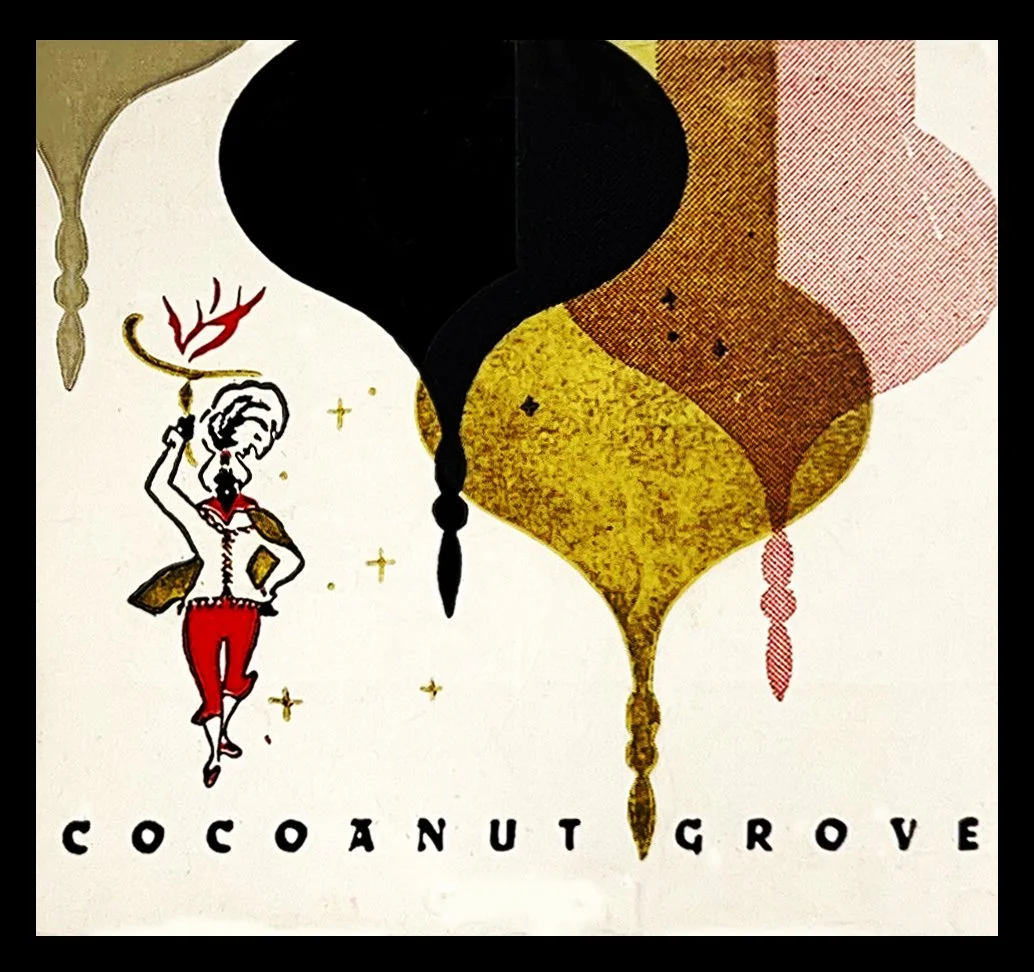
The 1957 renovation of the Cocoanut Grove included new menu and matchbook artwork
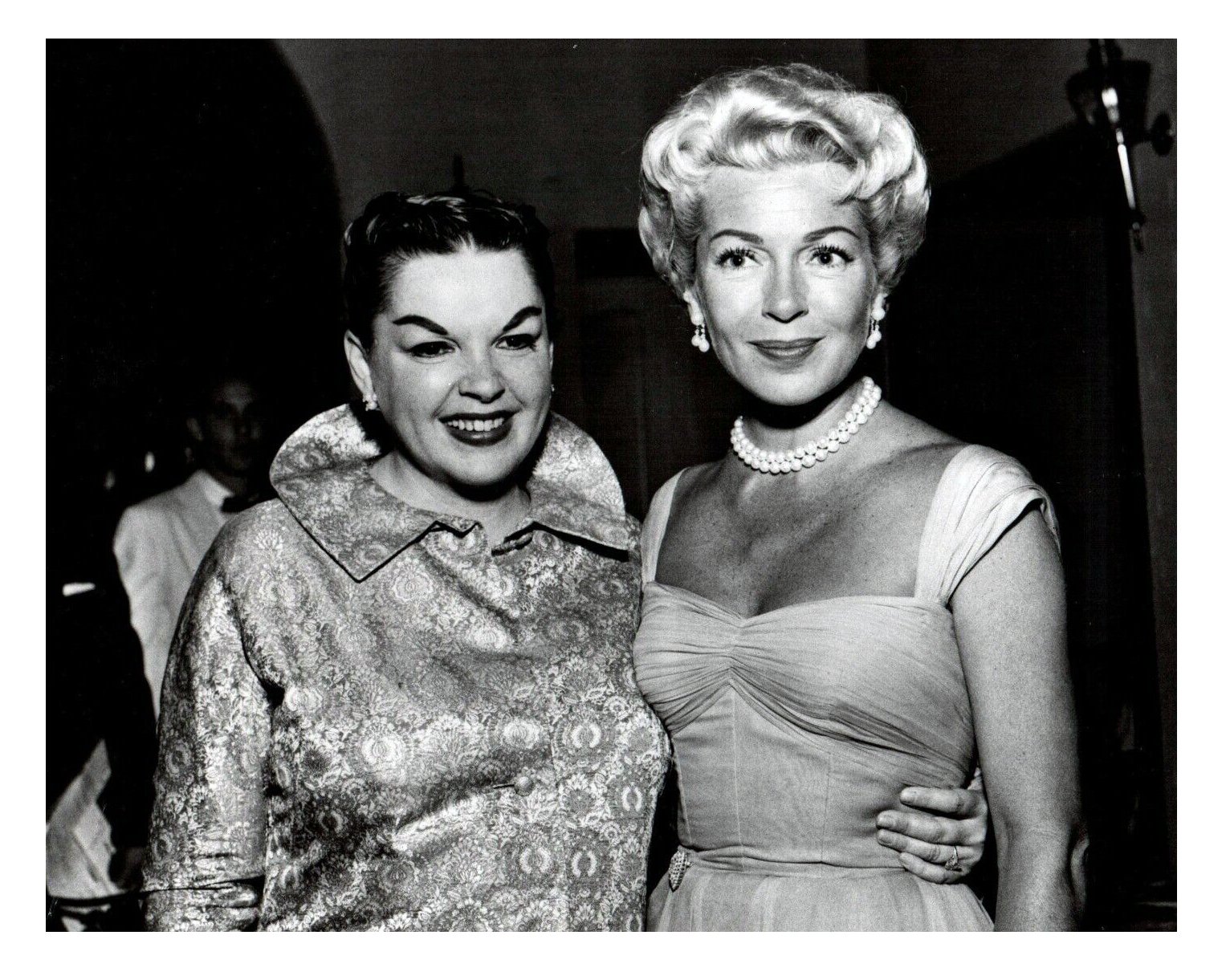
Lana Turner (right) attends a Judy Garland performance at the Cocoanut Grove
Sid Luft, Garland’s then husband and manager, remembered that successful run. “The Grove", however, was one of Judy’s “homes”, a place where she was relaxed and comfortable performing. Sinatra was there. Brando was there, and she’d schmooze the audience: ‘A long time ago I came down to the Grove with my mother, and she talked the orchestra leader into letting me sing a song…’
Garland’s first appearance at the Cocoanut Grove was in 1932. Her successful 1958 comeback was parlayed into a live recording of an album: Judy Garland at the Grove, that same year.
Other live albums recorded on stage include, Lena Horne At The Cocoanut Grove (1958), Sammy Davis Jr. At The Cocoanut Grove (1962) Jane Morgan At The Cocoanut Grove (1962) and Sergio Franchi - Live At The Cocoanut Grove (1965).
In July of 1961 Eddie Fisher was less successful when his comeback concert was hijacked by a heavily inebriated Rat Pack. The rowdy group interrupted the show on several occasions and disrupted Fisher’s concentration. His wife, Elizabeth Taylor, came to her hubby’s defense and went public with a strong rebuke of the Pack’s antics.
A 21-year-old Barbra Streisand was introduced to the Hollywood crowd with a stunning debut in August of 1963. Among the thrilled and impressed audience by the powerful young songstress was Natalie Wood. The successful Streisand debut would be followed by a roster of new and established talent including Nancy Wilson, Shirley Bassey, Tony Bennett, Trini Lopez, Barbara McNair, Paul Anka, Dinah Shore, Wayne Newton and The Supremes.
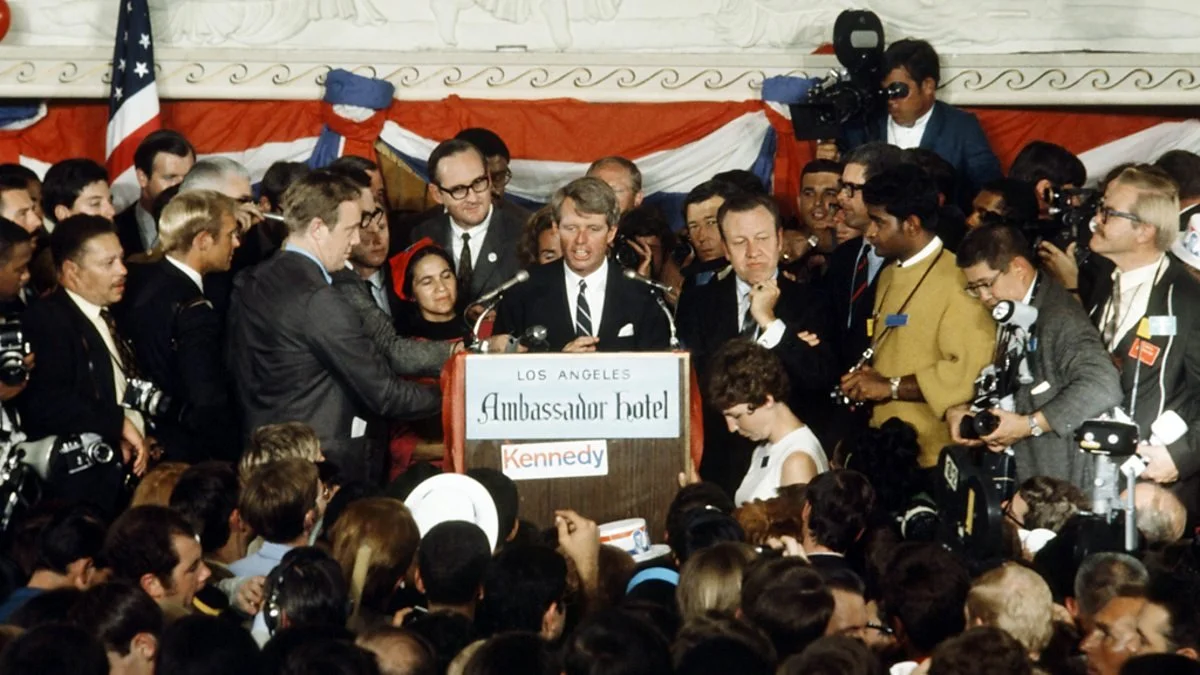
Robert Kennedy moments before being shot in the hotel’s pantry
During the 1960’s, the Cocoanut Grove would continue to struggle during a time of societies’ changing tastes and demographics. The events of the evening of June 4, 1968 would only accelerate the decline. After winning the California Democrat Primary, Presidential candidate Robert F. Kennedy gave a victory speech in the hotel’s Embassy ballroom. He and his enthusiastic entourage left the ballroom and exited through the hotel’s kitchen pantry. Minutes after his speech, pandemonium ensued, when he was shot in the head and later succumbed to his injuries.
Like the assassination of his brother, President John F. Kennedy, many conspiracies continue to surround RFK’s untimely death.
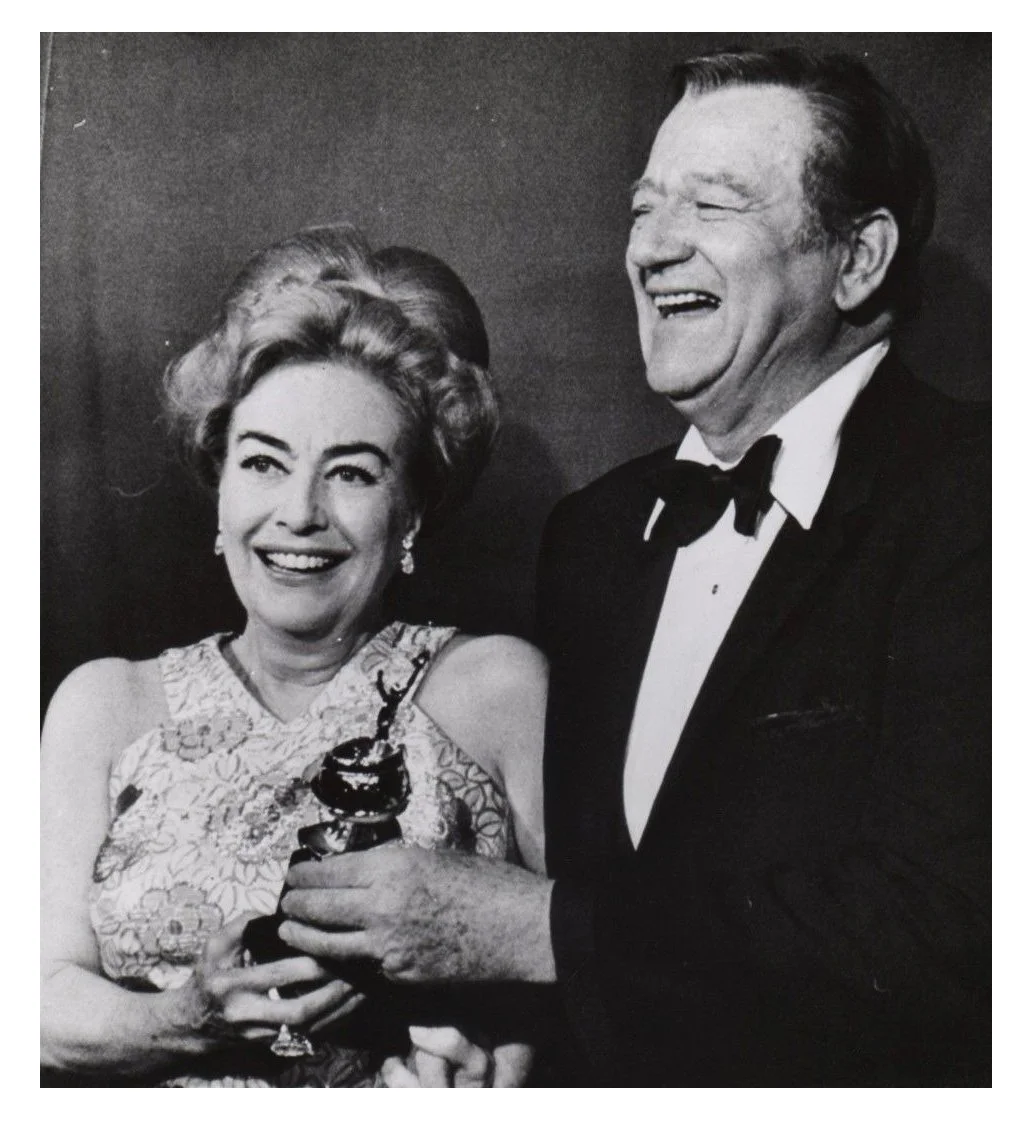
Joan Crawford receives the Cecil B. DeMille Award from John Wayne
Yet, despite the national tragedy, the grand old resort hotel would soldier on. The Hollywood Foreign Press Association held their Golden Globes award ceremonies there for 16 years. In 1970, recent Best Actor winner John Wayne (True Grit) presented Joan Crawford with the Cecil B. De Mille award.
Crawford told the crowd during her acceptance speech, “There was much drama right here in this hotel, so many lives were affected, some for better, some for worse. So many careers began…some even ended in this very room…What memories I have of this place.”
Her sentiments were both heartfelt and autobiographical. Crawford had no way of knowing it, but her well-chosen words could also be construed as an early and informal eulogy for the Cocoanut Grove.
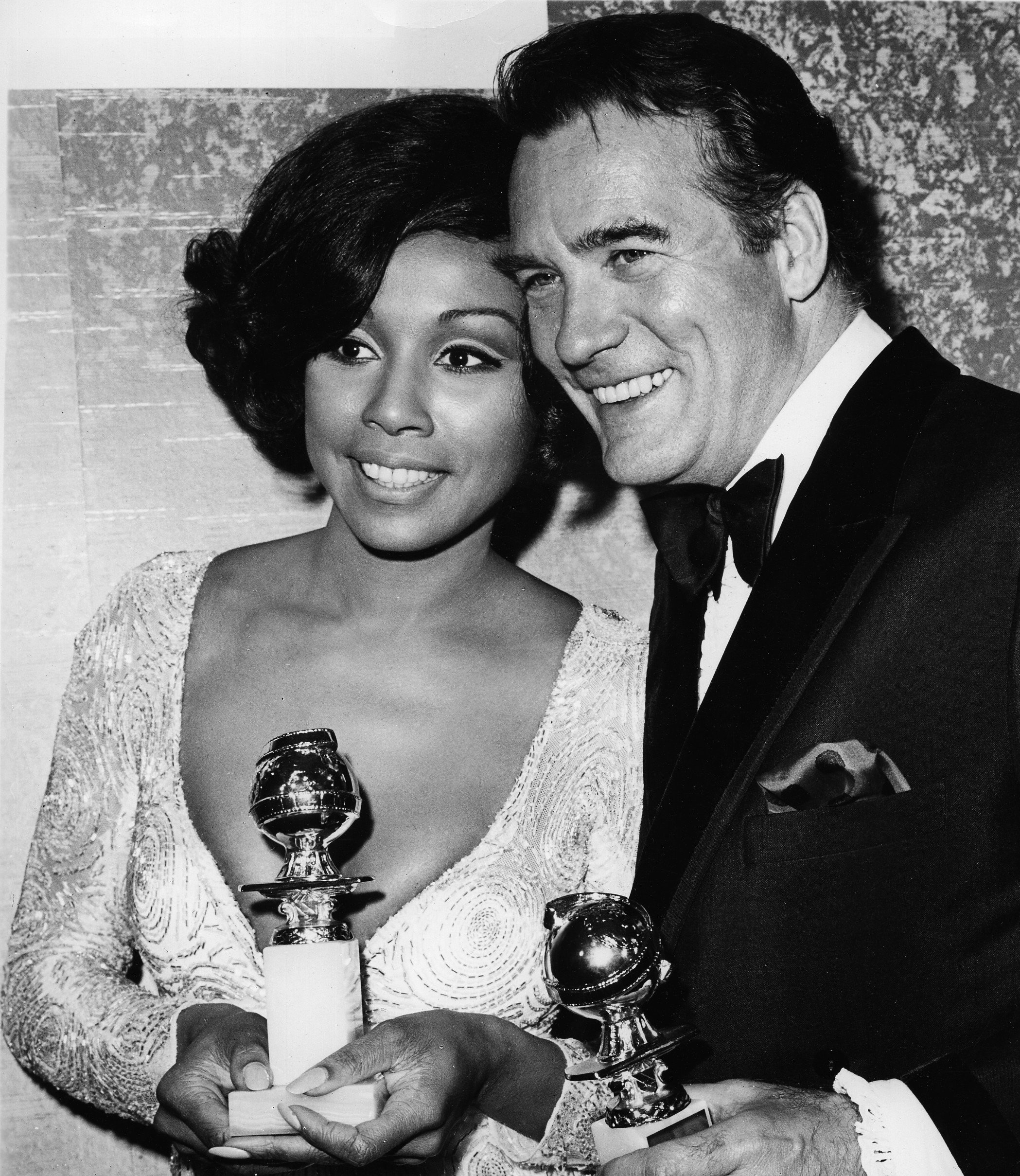
Diahann Carroll wins a Golden Globe for Best Performance in a Television Series, Actress (Julia) and Carl Betz wins Best Performance in a Television Series, Actor (Judd for the Defense) for 1968
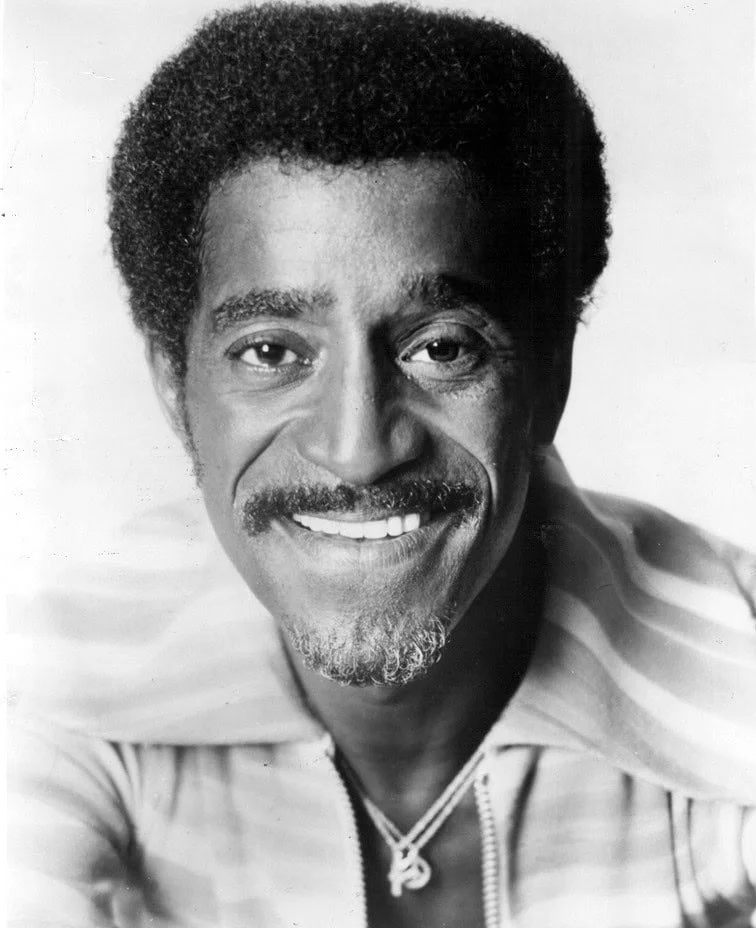
Sammy Davis Jr.
In an attempt to reverse the downward trend in attendance and prominence, the multi-talented Sammy Davis, Jr. mounted a gallant attempt to rebrand the Cocoanut Grove with the hipper “Now Grove” moniker, an all-new décor and featuring contemporary talent like Sonny and Cher, Sergio Franchi and Diana Ross. The result was a new showroom obviously influenced by the then booming entertainment and gambling casinos of Las Vegas. Unfortunately, most of what had made the Cocoanut Grove the Cocoanut Grove had now been eliminated. Adding insult to injury, all the effort was too late to reverse an undeniable trend, the “in” crowd had inevitably moved on. The hotel died a protracted death until it finally closed in 1989, making the Cocoanut Grove’s 68 year run the longest lasting of the Classic Hollywood nightclubs.
The Los Angeles Unified School District bought the property in 2001 with plans to raze the land for a proposed new school complex.
A gallant effort by a well-intentioned group of historic preservationists rallied to save the magnificent landmark. A professional presentation was drafted to turn the storied venue into a unique, state-of-the- art school. It already had everything a school would need; it just needed to be updated and modernized. But massive egos got in the way, like they so often do, and the Ambassador Hotel was ultimately demolished. Another casualty on the long list of Los Angeles landmarks destroyed in the name of “progress”. Ironically, the design clearly evokes the storied hotel and resort. And in a nod to Ambassador history, the new development was named The Robert F. Kennedy Community Schools.
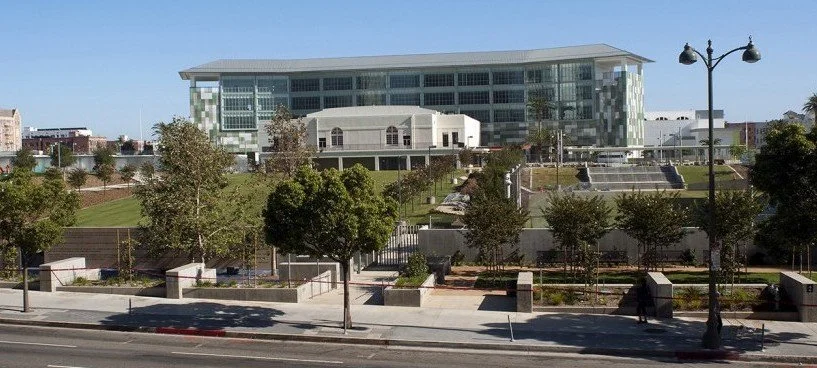
The Robert F. Kennedy Community Schools
This tragic loss symbolizes the sad result of backwards thinking and perhaps best represented by the lyrics of a Joni Mitchell song titled Big Yellow Taxi, “Don't it always seem to go That you don't know what you've got Till it's gone They paved paradise…”
What a tremendous loss to the community of a landmark that had once defined the limitless optimism and possibilities of early Los Angeles.
And on it goes…
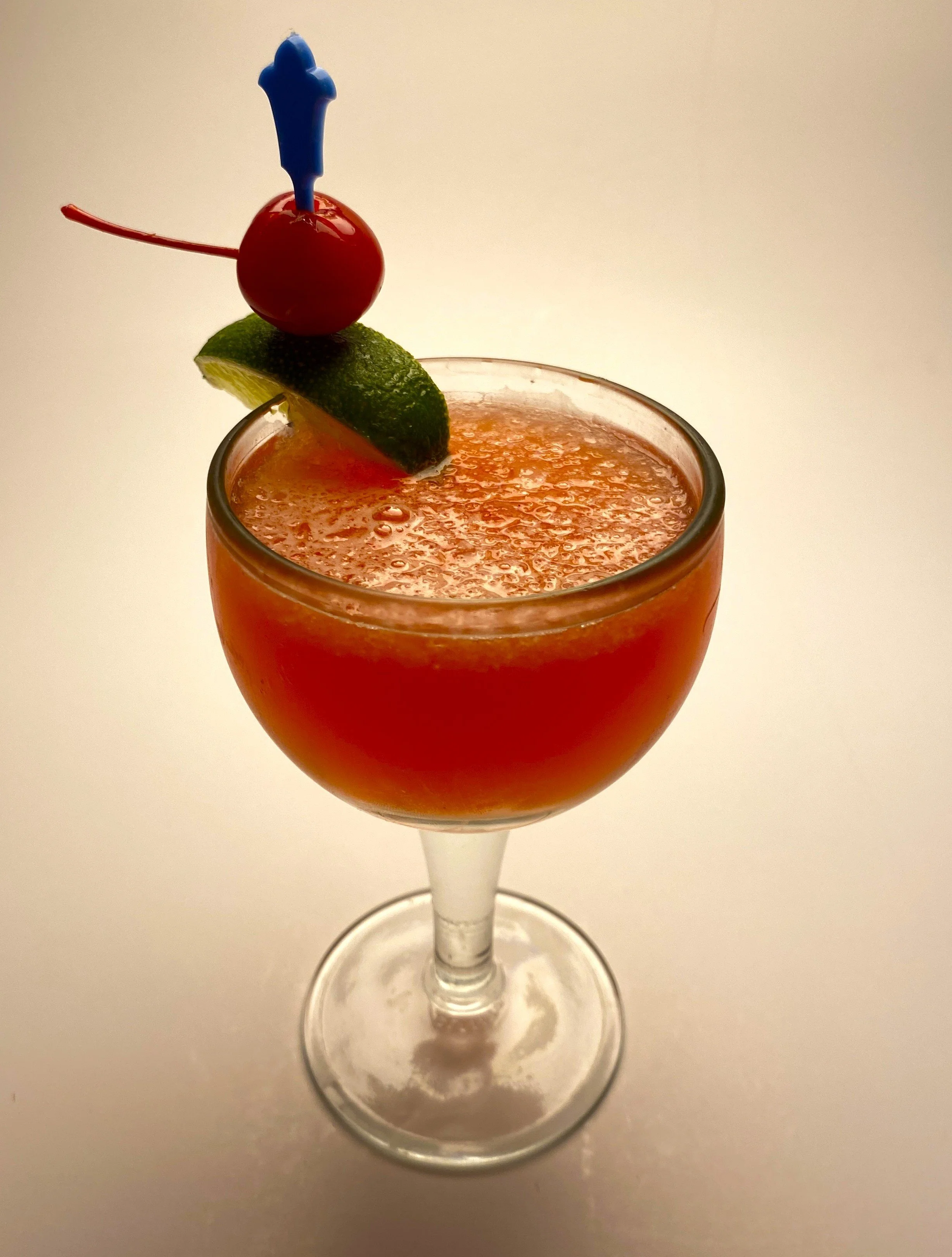
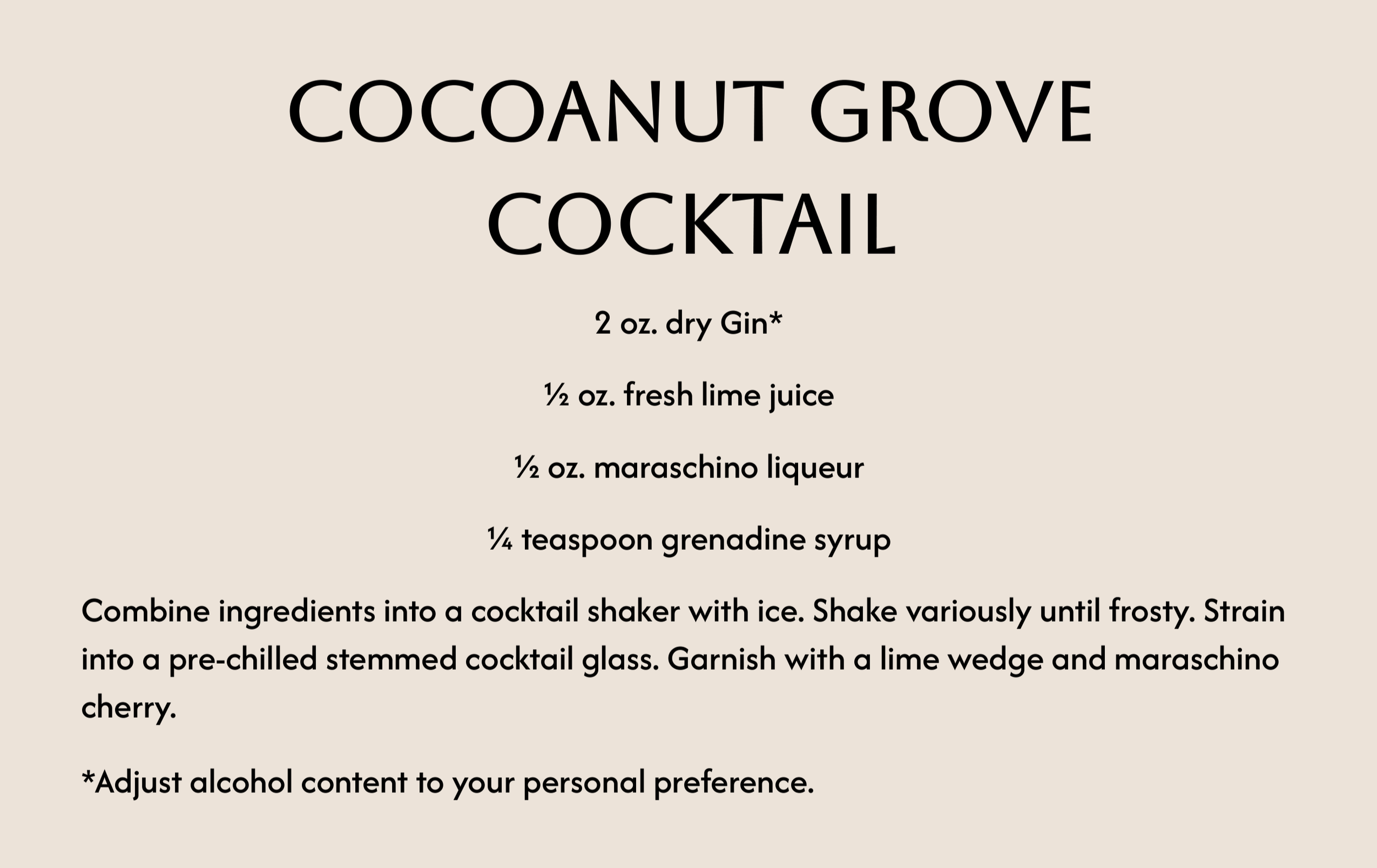
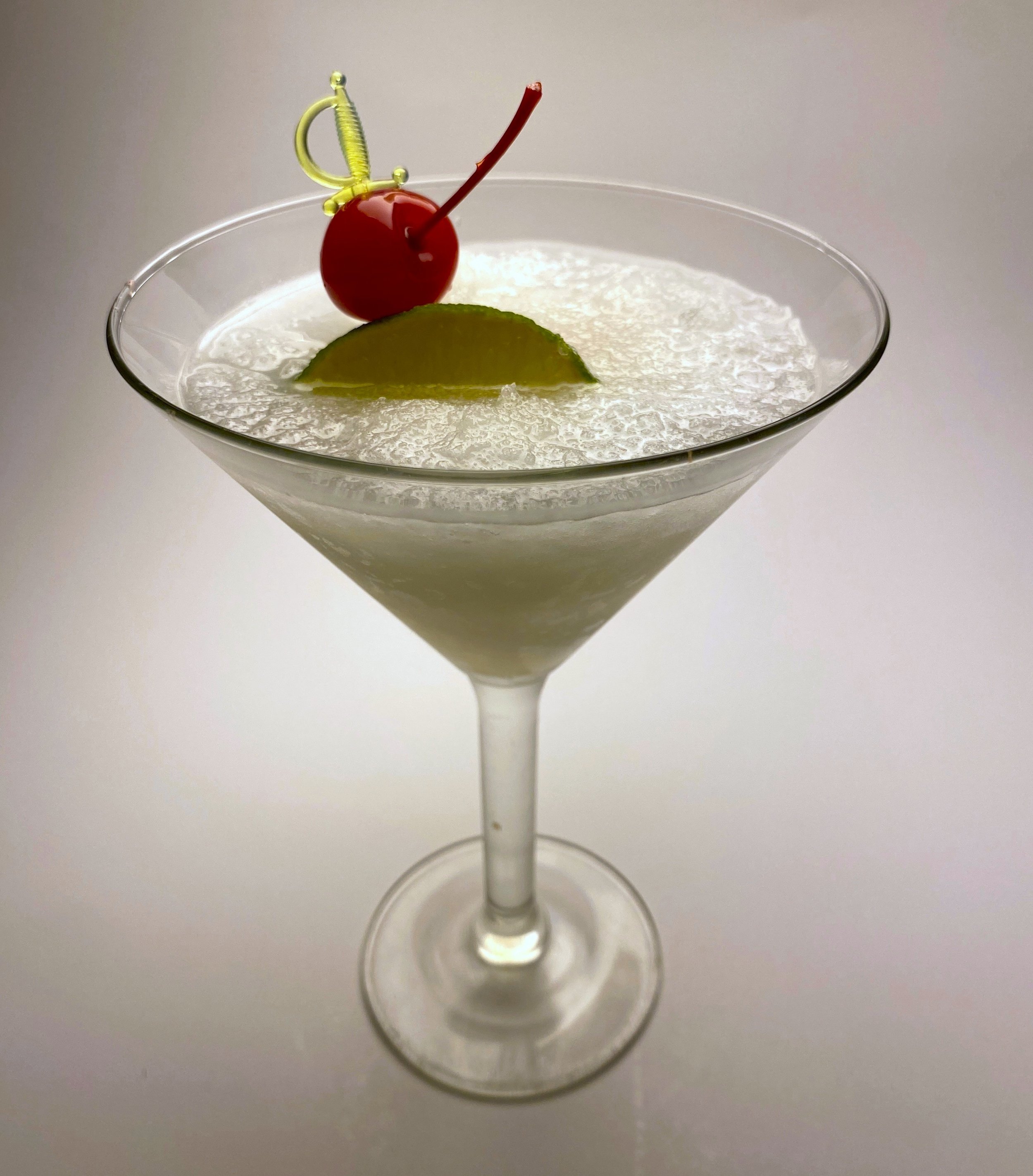
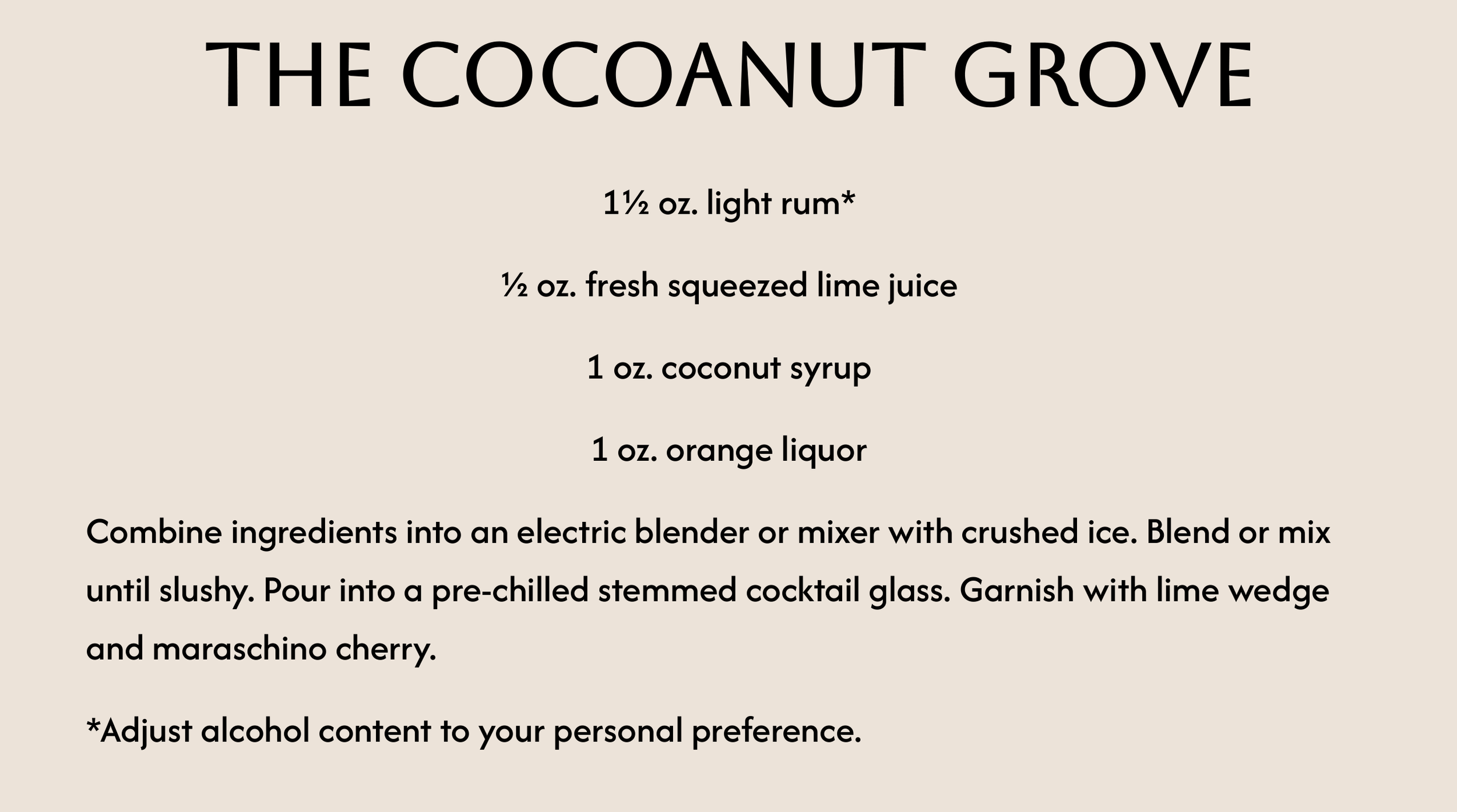
However, all is not lost; at least a taste of the Cocoanut Grove lives on with their famous cocktails.
Over the decades, the featured signature cocktails offered by the Cocoanut Grove included the Coconut Grove Cocktail, The Cocoanut Grove, the Coconut Grove Cooler, the Freddie Martin Frosted Daiquiri, the Daisy, the Gold Mist, the Cobbler, the Royal Purple, The Bag-Dad, and the Merry K cocktail.
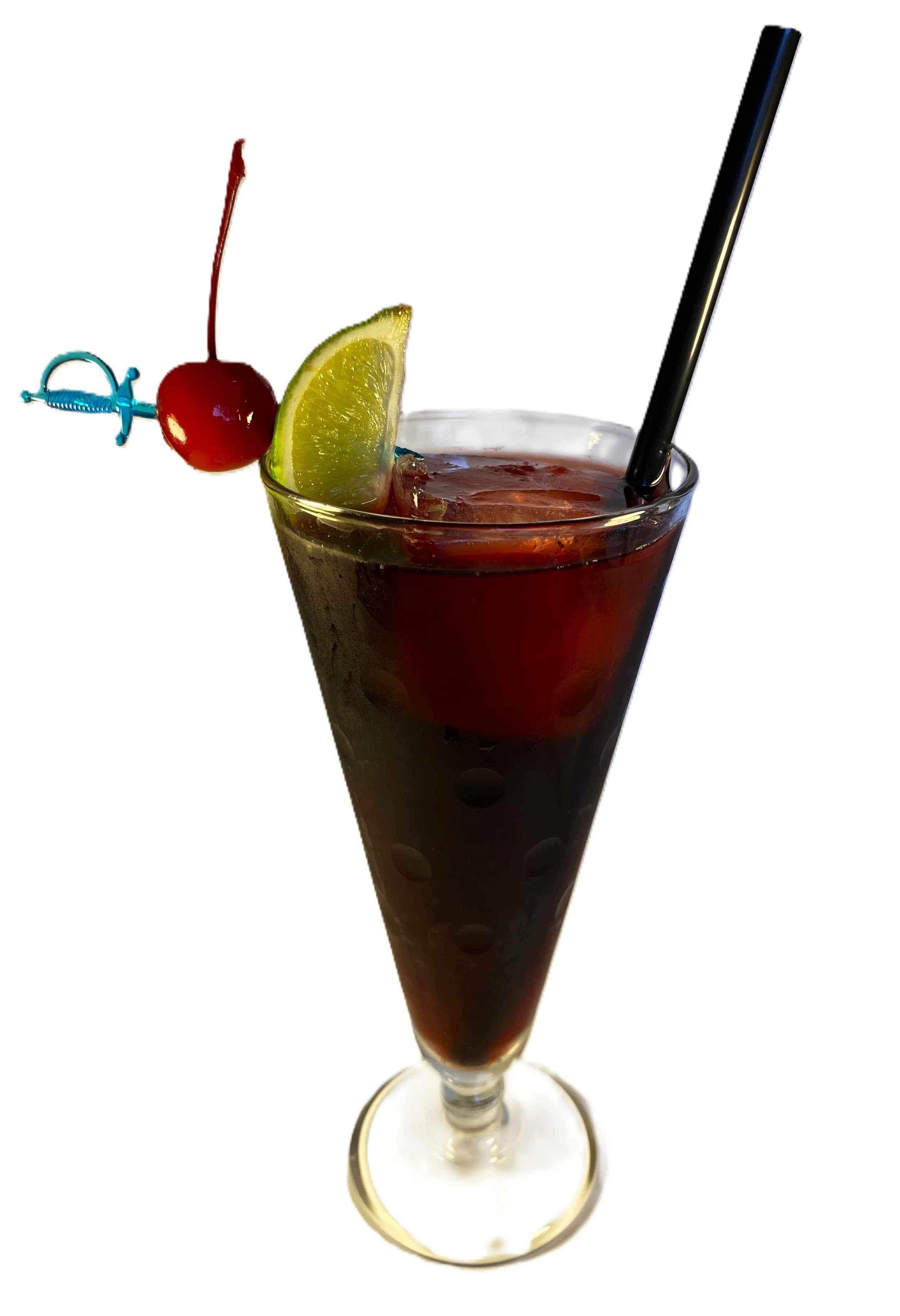
Royal Purple
1½ oz. white Rum
3 oz. Concord grape juice
½ oz. fresh squeezed lime juice
Combine ingredients into a blender or mixer with ice. Blend or mix until slushy. Pour into Collins glass and garnish with maraschino cherry and lime wedge.